The Importance of Men’s Gut Health
A gut is a gut, right? Not quite. Men's and women's guts respond differently to the same food — and two of the conditions men worry about most have a growing gut connection worth understanding.

It's time to put men's health into the gut health conversation, because it usually isn't.
Studies find that the same diet eaten by men and by women shapes the gut microbiome differently, and sex hormones are the mechanism most often proposed.1 Men also face higher rates of several conditions for reasons involving anatomy, hormones and behavior — the picture is genuinely more tangled than any single explanation.
Let's look at two where gut health may be a contributing factor.
Heart disease

Heart disease is the leading cause of death for both men and women in the United States, with a somewhat higher rate in men.2
"Heart disease" covers a lot of ground, but most of it starts with atherosclerosis — arteries becoming thick and stiff, restricting blood flow. That's driven by plaque building up in the artery wall: cholesterol and fat, yes, but also calcium, cellular debris and fibrous tissue, which is why the vessel hardens rather than simply narrowing.
Where the gut comes in
Two different ways.
What your bacteria don't make
Bacteria ferment dietary fiber into short-chain fatty acids, and those metabolites do useful work well beyond the gut. Eat little fiber, or lack the bacteria that ferment it, and you produce less of them.3
What your bacteria do make
This is the one with more evidence behind it. Gut bacteria convert choline and carnitine — abundant in red meat, eggs and dairy — into trimethylamine. The liver turns that into TMAO, and higher TMAO levels have been associated with increased cardiovascular risk.4,3
Which is a genuinely interesting inversion. It isn't only about what your gut community fails to produce. Sometimes it's what it produces.
Worth being clear on what kind of knowledge this is: a well-supported association and a plausible mechanism, not a settled instruction about what to eat. If you have cardiovascular risk factors, that conversation belongs with your doctor, who has tools that work.
Prostate cancer

Prostate cancer is the second most diagnosed cancer in men worldwide — around 1.47 million cases in 2022, behind only lung cancer. In the United States, and in more than half the countries in the world, it's the most commonly diagnosed cancer in men.5
It's associated with chronic inflammatory conditions of the urinary tract, including chronic prostatitis and benign prostatic hyperplasia. The proposed gut link is indirect: the microbiome influences metabolic processes that feed into chronic inflammation, and inflammation is well established as a contributor to cancer development generally.6
The more recently mapped urinary microbiome adds another thread — potentially toward better understanding and less invasive diagnostics.7
We should be straight about how early this is. The gut-prostate connection is largely associative, the researchers themselves say a great deal more work is needed, and none of it changes what you should actually do: talk to your doctor about screening, on the schedule that suits your age and family history. That conversation saves lives. Nothing on this page does.
So what's actually worth doing?

A healthy gut is a decent foundation for every man, woman and child, and the list is the same unglamorous one it always is.
We've drifted a long way from a life that involved working in dirt and preserving food by fermentation. Both of those used to put us in constant contact with a wide range of microbes without anyone deciding to. Now that variety is a choice you have to make on purpose.
- Eat a genuinely varied diet, heavy on fiber
- Include fermented foods you'll actually eat
- Move, sleep, and drink less alcohol
- Keep your screening appointments
Chips, fast food and candy bars will meet your calorie requirement without much argument. They just leave the rest of the job undone.
More on the specifics in Probiotics for Men and Gut Health and Testosterone.
Where does Flourish fit?
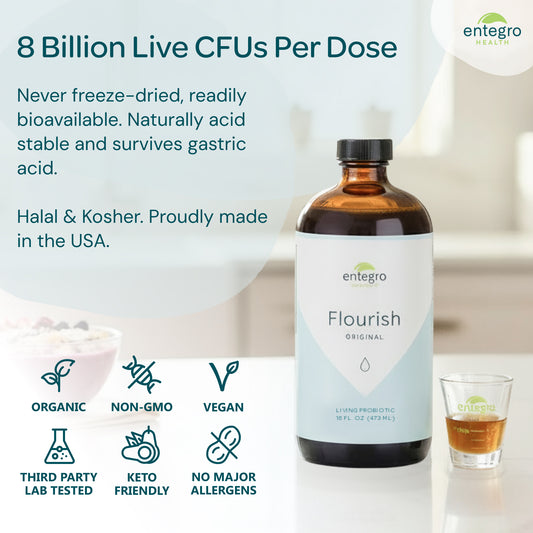
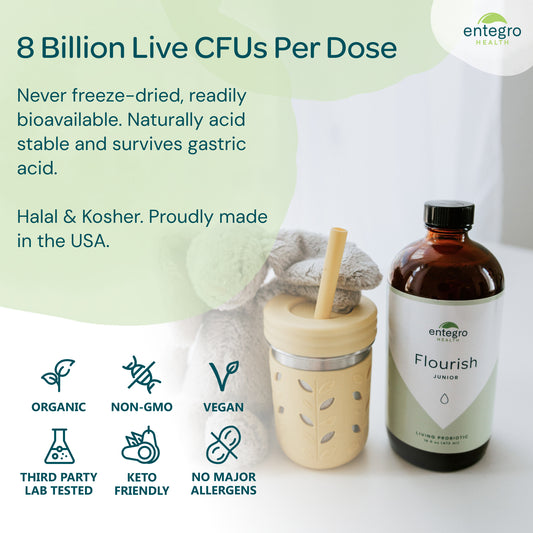
Flourish Original and Flourish Junior are living liquid probiotics — eleven strains, small-batch fermented in Iowa — taken daily to support digestive and microbiome health.
That's the whole claim, deliberately. Everything above about heart disease and prostate cancer is research context, not a reason to buy a supplement, and we're not going to pretend a daily shot belongs in the same sentence as cardiology or oncology.
Flourish is a dietary supplement made to support digestive and microbiome health. It is not a treatment for, and will not prevent, heart disease, prostate cancer or any other condition. If you have cardiovascular risk factors or urinary symptoms, or you are due for prostate screening, see your doctor. Check with them before starting a new supplement.

Ready to try a living probiotic?
Eleven living strains. One daily shot. For the whole family.
Shop Flourish Original · Shop Flourish Junior · Why we keep it liquid
A few questions we hear a lot
Do men and women really have different gut microbiomes?
The research consistently finds differences, including in how the same diet affects each, with sex hormones the mechanism most often proposed.1 Why it happens is less settled than that it happens.
What is TMAO?
Trimethylamine N-oxide. Gut bacteria turn choline and carnitine from red meat, eggs and dairy into trimethylamine; the liver converts it to TMAO, and higher levels have been associated with cardiovascular risk.4 It's an association and an active area of research, not a reason to panic about eggs.
Can a probiotic lower my heart disease risk?
We're not claiming that, and you should treat anyone who does with suspicion. The evidence-backed levers are the familiar ones — diet, movement, not smoking, alcohol, and whatever your doctor prescribes.
How common is prostate cancer?
It's the second most diagnosed cancer in men worldwide, and the most commonly diagnosed in men in the United States.5 Which is exactly why screening conversations matter.
Does gut health affect prostate cancer?
It's an open question. The proposed route is indirect — through chronic inflammation — and the evidence so far is largely associative.6 Interesting, early, and not something to act on in place of screening.
What's the single most useful thing I can change?
Fiber, probably, because most men eat far too little of it and it moves several needles at once. But the honest answer is whichever one you'll keep doing.
About this article
Written by: Lorilyn Van Dyke, Entegro Health | Originally published: June 2021
Important information
This article is for general education and isn't a substitute for professional medical advice, diagnosis, or treatment. It does not replace prostate cancer screening or cardiovascular risk assessment — please speak to your physician about both, on the schedule appropriate to your age and family history. Always seek qualified advice before starting a new supplement. These statements have not been evaluated by the Food and Drug Administration. This product is not intended to diagnose, treat, cure, or prevent any disease.
Sources
- Kim, Y. S., Unno, T., Kim, B. Y., & Park, M. S. (2020). Sex Differences in Gut Microbiota. The World Journal of Men's Health, 38(1), 48–60. Source
- Centers for Disease Control and Prevention, National Center for Health Statistics. Leading Causes of Death. Source
- Trøseid, M., Andersen, G. Ø., Broch, K., & Hov, J. R. (2020). The gut microbiome in coronary artery disease and heart failure: Current knowledge and future directions. EBioMedicine, 52, 102649. Source
- Tang, W. H. W., Wang, Z., Levison, B. S., et al. (2013). Intestinal microbial metabolism of phosphatidylcholine and cardiovascular risk. New England Journal of Medicine, 368(17), 1575–1584. Source
- World Cancer Research Fund International. Prostate cancer statistics — 1,467,854 new cases worldwide in 2022; second most common cancer in men. Source
- Katongole, P., Sande, O. J., Joloba, M., Reynolds, S. J., & Niyonzima, N. (2020). The human microbiome and its link in prostate cancer risk and pathogenesis. Infectious Agents and Cancer, 15, 53. Source
- Neugent, M. L., Hulyalkar, N. V., Nguyen, V. H., Zimmern, P. E., & De Nisco, N. J. (2020). Advances in Understanding the Human Urinary Microbiome and Its Potential Role in Urinary Tract Infection. mBio, 11(2), e00218-20. Source