Made to Move
Everyone knows exercise is good for us. Fewer people know it's also good for the trillions of tenants living in our gut — and that the relationship runs both ways. We were all made to move.

First, the question I get asked most
I come from a fitness background, and some version of this comes up constantly:
What is the #1 best type of exercise of all time?
It's a good question with a boring answer. The best exercise is the one you're going to do. Something is always better than nothing.
Our bodies are remarkably adaptable. They respond to the stresses placed on them — or not placed on them — and adjust to meet those demands. And as is so often the case with the microbiome, it turns out to be a two-way street. Your exercise influences the bacteria living down there. Those bacteria, in turn, appear to influence how you move and how you perform.

What exercise appears to do for your gut
Before we go further, one honest caveat. Most of what follows comes from rodent studies. They're genuinely interesting and they point somewhere real, but a rat on a running wheel is not a person on a treadmill. Where we have human data, we'll say so.
The colon cancer link, with the nuance intact
A 1997 review found a consistent inverse relationship between physical activity and colon cancer, reporting roughly a 50% lower incidence among the most active people across numerous studies.1
That's still what the paper says, but it's nearly thirty years old, and more recent work has tempered it — current estimates put the relative risk reduction closer to 20%.2 Still a real, worthwhile effect. Just not the one that fits neatly on a poster.
The mechanism was never spelled out in that early work. The current thinking is that part of the pathway runs through bacterial diversity, which in turn increases production of short-chain fatty acids — acetate, propionate and butyrate.3
Your gut behaves a bit like an endocrine organ
Here's the part I find genuinely elegant.
Those short-chain fatty acids get absorbed through the mucosa, the topmost lining of the intestine, then picked up by blood or lymph and carried to tissue elsewhere in the body. Researchers now describe the microbiome as functioning somewhat like an endocrine organ — where the endocrine system releases hormones into the bloodstream, your gut bacteria release compounds that travel and act at a distance.3
One notable destination is the brain, which is where a good deal of the current "gut-brain axis" thinking comes from. All of it contributes to homeostasis: the body's ability to hold a steady equilibrium while a thousand processes run in the background.
The rat study everyone cites
In 2008, researchers gave rats access to a running wheel for five weeks and compared them to sedentary rats. The microbiota composition was notably different between the two groups, and the exercised rats had significantly higher n-butyrate concentrations in the cecum — the pouch at the start of the large intestine where a great many of the good bacteria live.4
Butyrate is the fuel the cells lining your gut actually run on, so more of it is a good sign for the health of that barrier.
And the one about performance
Diversity may also matter for endurance. A 2015 study put three groups of mice through a swim-to-exhaustion test: germ-free mice with no gut bacteria at all, mice colonised with a single strain of Bacteroides fragilis, and mice with a normal microbiome.5
The germ-free mice lasted about half as long as the normal-microbiome mice. The single-strain mice landed in between. The germ-free group also showed lower levels of antioxidant enzymes, which the authors suggest contributed to the drop-off.
Mice, again. But it's a striking result — the bacteria weren't doing the swimming, and it still made a difference.
What we know from actual humans
The best human evidence comes from a study of professional rugby players, whose gut microbiota showed greater diversity than matched non-athlete controls.6 Worth noting that elite athletes also eat very differently, and the study was upfront that diet and exercise are hard to untangle here.
Take care of your gut lining and it will take care of you
The intestine's primary job is absorption — nutrients, fluids, electrolytes. It's the gatekeeper that keeps the good stuff in and the bad stuff out.
A happy, diverse bacterial population produces short-chain fatty acids. Those support the lining of the intestine. A healthy lining keeps the bacteria happy. Round and round it goes, and keeping that loop in balance is the whole game.
Exercise training appears to support a more diverse, health-promoting bacterial population while reducing pathogenic species. And the bacterial profiles found in exercising groups resemble those of people at reduced risk of type 2 diabetes and obesity.3
Which kind of exercise?
Most microbiome research has looked at cardiovascular endurance and athletic performance, so that's where the evidence is strongest. Strength training shows beneficial outcomes too. Yoga has long been credited with supporting digestion through twisting and, just as importantly, stress management.
So: no bad options. Pick the one you'll actually keep doing.

Challenge accepted
Here's my challenge: move in a new way, for your benefit and your microbiome's. As we age, flexibility and strength matter more, not less. Sign up for a yoga class. Book a session with a qualified fitness professional and find out what's actually available to you.
Eight things worth knowing as you start, or start again:
1. Commit to a minimum of six weeks
Long enough that you'll begin to notice the changes you're making. If flexibility is your goal, remember you didn't get this inflexible in six weeks either. Give yourself room. Learning new things doesn't just happen — it takes work, and it can also be fun.
2. Don't compare
I cannot stress this enough. Sure, Karen started the same program on the same day you did. You are two different people with two different lives and two different histories. You're on your journey, not Karen's.
3. Sweating and being out of breath is not a bad thing
Somehow sweating has picked up a bad reputation. When the breathing gets heavy and the sweat starts, try to file that under good news rather than bad. It's a mental attitude choice. Go in expecting it, expect mild discomfort, and know that the gains are being made inside the discomfort.
4. Find a workout buddy
There are plenty of days I don't want to get out of bed, especially in winter. Thankfully I know my friend Marci will be waiting. A small nudge is often all it takes. And it's always good to have someone to be in misery with, or to complain about the workout with afterwards. Even syncing schedules for streamed workouts with a friend helps.

5. Put it in your schedule
You're busy. Work, school runs, co-curriculars, church, lessons, food prep, and a hundred other genuine claims on your time. These are real constraints, not excuses.
Stack activities where you can. Ride a bike or use the elliptical while you prep for a meeting. Meeting a friend for coffee? Suggest a walk instead. Even stretching or foam rolling through reruns of The Office counts.
6. Listen to your body
Feeling seriously sore, or sensing a cold coming on? Back off the intensity or skip the day. What I'd recommend against is skipping two scheduled workouts in a row — it's simply too easy not to come back after that. Illness aside, something is always better than nothing.
7. Feed the gut you're asking to work
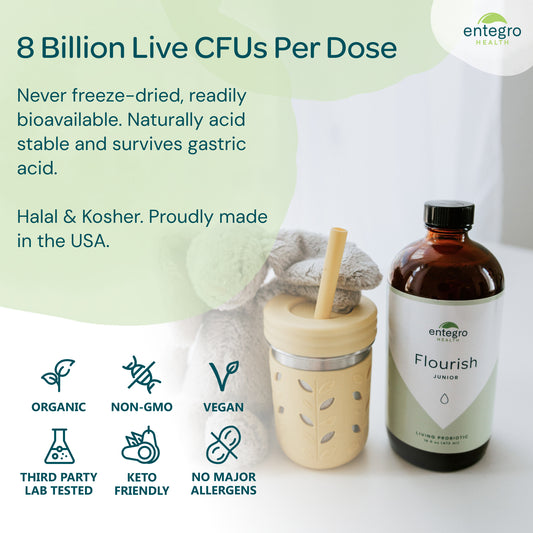
Fermentable fiber from a range of plants, fermented foods where you enjoy them, and if it suits you, a living probiotic. Flourish Original and Flourish Junior each supply eleven strains from five different families — a group your resident gut buddies would be glad to meet.

Original and Junior are the same probiotic, incidentally — same strains, same small-batch ferment, same third-party testing. Original ferments on molasses and tastes stout; Junior ferments on sorghum and tastes sweet, closer to apple cider. It's a flavor choice, not an age one.
Flourish is a dietary supplement made to support digestive and microbiome health. It isn't a treatment for any condition and it won't do your workout for you. Talk to your doctor before starting a new supplement or a new exercise program, particularly if you have an existing health condition.
8. Find joy in movement
We were made to move, and moving can create joy. I've had many clients over the years with genuinely miserable middle-school PE memories, and it saddens me every time. The good news: you are not the person you were in middle school, and there are a great many ways to move that have nothing to do with the dodgeball days of old.

Ready to try a living probiotic?
Eleven living strains. One daily shot. For the whole family.
Shop Flourish Original · Shop Flourish Junior · Why we keep it liquid
A few questions we hear a lot
Does exercise really change your gut bacteria?
The evidence says it appears to, though most of it comes from animal studies. Exercised rats show different microbiota composition and significantly more butyrate than sedentary ones, and professional athletes show greater microbial diversity than matched controls.4,6 How much of that is the exercise and how much is the diet that goes with it is still being worked out.
What kind of exercise is best for gut health?
Aerobic exercise is the most studied, so that's where the evidence is strongest — but strength training shows benefits too, and there's no signal that any common form of movement is bad for your gut. The best one remains the one you'll keep doing.
Will a probiotic make me a better athlete?
We're not going to claim that. The mouse work is suggestive, and there's early human research on probiotics and time to exhaustion, but it's a long way from settled. Take one to support your gut, not to chase a personal best.
What are short-chain fatty acids and why do they matter here?
They're what your bacteria produce when they ferment fiber — acetate, propionate and butyrate. Butyrate in particular is the fuel used by the cells lining your gut, which is why more of it is a good sign for that barrier.3
How long before I notice anything?
Give any new routine at least six weeks before you judge it. Flexibility especially takes time — you didn't lose it in a fortnight.
About this article
Written by: Lorilyn Van Dyke, Entegro Health | Originally published: January 2020
Important information
We're proactive health enthusiasts, not doctors. This article is for general education and isn't a substitute for professional medical advice, diagnosis, or treatment. Talk to your physician or another qualified provider before starting a new exercise program or supplement, especially if you have an existing health condition. These statements have not been evaluated by the Food and Drug Administration. This product is not intended to diagnose, treat, cure, or prevent any disease.
Sources
- Colditz, G. A., Cannuscio, C. C., & Frazier, A. L. (1997). Physical activity and reduced risk of colon cancer: implications for prevention. Cancer Causes & Control, 8(4), 649–667. Source
- What is the optimal type and dose of physical activity for colorectal cancer prevention? (2023). Source
- Campbell, S. C., & Wisniewski, P. J. (2017). Exercise is a Novel Promoter of Intestinal Health and Microbial Diversity. Exercise and Sport Sciences Reviews, 45(1), 41–47. Source
- Matsumoto, M., Inoue, R., Tsukahara, T., Ushida, K., Chiji, H., Matsubara, N., & Hara, H. (2008). Voluntary Running Exercise Alters Microbiota Composition and Increases n-Butyrate Concentration in the Rat Cecum. Bioscience, Biotechnology, and Biochemistry, 72(2), 572–576. Source
- Hsu, Y. J., Chiu, C. C., Li, Y. P., Huang, W. C., Huang, Y. T., Huang, C. C., & Chuang, H. L. (2015). Effect of intestinal microbiota on exercise performance in mice. Journal of Strength and Conditioning Research, 29(2), 552–558. Source
- Clarke, S. F., Murphy, E. F., O'Sullivan, O., et al. (2014). Exercise and associated dietary extremes impact on gut microbial diversity. Gut, 63(12), 1913–1920. Source