Women as Bacterial Hosts
Men and women carry measurably different gut communities, and the leading explanation is hormones. Which means that for roughly half the population, the gut is working against a monthly moving target.

Studies keep finding sex differences in gut microbiota, and the mechanism most often proposed is the one you'd guess: the hormones.1
The female reproductive system is genuinely remarkable — a recurring cycle requiring detailed regulation across a lot of moving parts. That natural ebb and flow makes menstruation and reproduction possible, and it affects the whole person, gut included.
Which hormones are we actually talking about?
Four of them do most of the work.
Follicle stimulating hormone (FSH)
Produced in the pituitary gland at the base of the brain and released into the bloodstream, which carries it down to the ovaries. It does exactly what the name says: stimulates the growth of follicles on the ovary, creating a space for an egg to develop.2
Luteinizing hormone (LH)
Also from the pituitary, and it matters at two separate moments. Through the first half of the cycle it works alongside FSH to get the developing follicle producing estrogen. Then a sharp surge in LH triggers ovulation, releasing the matured egg to begin its journey down the fallopian tube.2
The textbook timing is around day 14, which assumes a 28-day cycle. Plenty of perfectly normal cycles aren't 28 days, so treat it as a landmark rather than an appointment.
Estrogen
Produced in the ovaries, under instruction from the hypothalamus and pituitary. Levels swing considerably across a cycle: lowest during menstruation, climbing through the follicular phase to peak just before ovulation — that peak is what triggers the LH surge — then dropping and rising again more modestly in the luteal phase.2
Its jobs include maturing the egg and thickening the lining of the uterus, in case an egg is fertilized and needs somewhere to implant.
Progesterone
Released in the second half of the cycle by the corpus luteum — the structure left behind on the ovary after the egg is released. Its job is to prepare the body for pregnancy and maintain one if it happens.2
If the egg isn't fertilized, the corpus luteum breaks down, progesterone falls away sharply, and the cycle begins again.
Why does my gut change with my cycle?

Because it's downstream of all that.
Loose stools, bloating, abdominal discomfort and constipation are common complaints among women of childbearing age, and they often track with the cycle rather than arriving at random. Research examining women with irritable bowel syndrome found gastrointestinal symptoms varying in step with fluctuating ovarian hormones.3
There's a plausible mechanism behind at least part of it. Progesterone has anti-inflammatory properties, and laboratory work on primary human gut tissue and cultured intestinal cells found that progesterone reduced gut permeability by increasing occludin, one of the proteins that forms tight junctions between cells in the gut lining.4
Worth knowing what kind of finding that is. It's tissue and cell work describing a mechanism, not a study of pregnant women. It suggests why the effect might exist rather than measuring it in a person.
About "estrogen dominance"
You'll see the term everywhere, and it's worth knowing that it isn't a medical diagnosis. It was popularized in the 1990s outside mainstream endocrinology, there's no agreed lab threshold for it, and no major medical body recognizes it as a condition.5
What clinicians describe instead is unopposed estrogen, and it's a more useful idea because it comes with an explanation. Progesterone only rises after ovulation. If ovulation doesn't happen — which is common in perimenopause and in several other situations — progesterone never arrives, and estrogen acts without its counterweight.5
The symptoms people describe are real. It's the label that's imprecise, and "why isn't ovulation happening?" is a far better question than "how do I lower my estrogen?" That one belongs with a doctor.
What happens during pregnancy, and after?
Once a placenta is established it takes over progesterone production from the corpus luteum, and output climbs substantially through to the third trimester.2
Then delivery happens and that production stops, more or less at once. The drop is one of the sharpest hormonal shifts the body ever makes.
Postpartum hair shedding is the most visible consequence and one of the best understood: high estrogen during pregnancy keeps more hairs in their growing phase than usual, and when levels fall those hairs shed together a few months later.6 It's temporary, it's normal, and it looks alarming in the shower.
If what you're experiencing after birth is about mood rather than hair, please talk to your provider. That's a conversation worth having early rather than waiting to see whether it passes.
What changes at menopause?

The monthly hormonal rhythm winds down, and everything that was regulated by it has to find a new normal. That includes the gut microbiome.1
Some women have a great many symptoms; others sail through with very few. Much of that isn't within anyone's control. What is within reach is supporting the gut through the transition, and the two-way conversation it's part of.
So what actually helps?

The unglamorous list, which is the same one that helps almost everything else:
- High-fiber foods — what your gut bacteria actually eat
- Movement, in whatever form you'll keep doing
- Adequate sleep
- Stress management, which is easy to write and hard to do
- A diverse daily probiotic
And pay attention to the pattern
If you find yourself on a yo-yo of loose stools and constipation, try mapping the ups and downs against your cycle for a couple of months. Most people have never looked, and the pattern is often clearer than expected.
As with most things involving the gut, the traffic runs both directions. Disruption to the gut microbiome may play a role in hormonal disruption, and hormonal disruption may play a role in the other.1
The human body is an extraordinarily chatty piece of engineering. Instead of words it uses hormones, neurons, and metabolites produced by gut bacteria to get a message where it needs to go.
Where does Flourish fit?
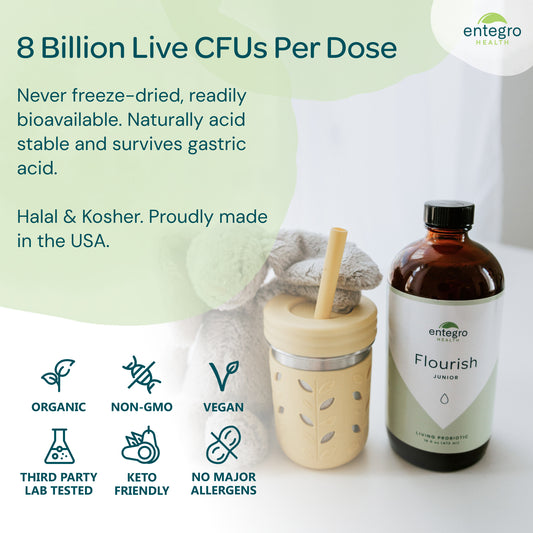
Flourish Original and Flourish Junior are living liquid probiotics — eleven strains from five families, small-batch fermented in Iowa — taken daily to support digestive and microbiome health.
That's the gut side of the conversation. It isn't a hormone treatment, and nothing here should replace a discussion with your doctor about a cycle that's causing you trouble.
Flourish is a dietary supplement made to support digestive and microbiome health. It isn't a treatment for hormonal conditions, menstrual symptoms, menopause or any other medical condition. Check with your doctor before starting a new supplement, particularly during pregnancy or while breastfeeding.

Ready to try a living probiotic?
Eleven living strains. One daily shot. For the whole family.
Shop Flourish Original · Shop Flourish Junior · Why we keep it liquid
A few questions we hear a lot
Is "estrogen dominance" a real condition?
Not as a diagnosis. There's no agreed lab threshold and no recognition by major medical bodies.5 The precise version is unopposed estrogen — progesterone doesn't rise because ovulation didn't occur. The symptoms are real; the label is the imprecise part.
Why does my digestion change before my period?
Ovarian hormones fluctuate sharply across the cycle, and gastrointestinal symptoms have been observed varying in step with them.3 Progesterone in particular appears to influence the gut barrier at the tissue level.4
Do men and women really have different gut bacteria?
Yes — animal and human studies both show sex differences in gut microbiota, with sex hormones the most commonly proposed explanation.1
Is postpartum hair loss permanent?
No. It's a temporary shedding caused by the hormonal drop after delivery, and it typically resolves on its own within several months.6
Will a probiotic balance my hormones?
We're not claiming that, and you should be wary of anyone who does. Flourish supports digestive and microbiome health. Hormones are a conversation for your doctor.
Should I track my cycle alongside my symptoms?
It's genuinely useful. Two or three months of notes turns "my stomach is unpredictable" into something with a pattern — and gives your provider something concrete to work with.
About this article
Written by: Lorilyn Van Dyke, Entegro Health | Originally published: May 2021
Important information
This article is for general education and isn't a substitute for professional medical advice, diagnosis, or treatment. Always seek the advice of your physician or another qualified health provider with any questions regarding a medical condition, hormonal symptoms, pregnancy or menopause, and before starting a new supplement. These statements have not been evaluated by the Food and Drug Administration. This product is not intended to diagnose, treat, cure, or prevent any disease.
Sources
- Kim, Y. S., Unno, T., Kim, B. Y., & Park, M. S. (2020). Sex Differences in Gut Microbiota. The World Journal of Men's Health, 38(1), 48–60. Source
- Society for Endocrinology. You and Your Hormones — follicle stimulating hormone, luteinising hormone, oestrogen and progesterone. Source
- Heitkemper, M. M., & Chang, L. (2009). Do fluctuations in ovarian hormones affect gastrointestinal symptoms in women with irritable bowel syndrome? Gender Medicine, 6(Suppl 2), 152–167. Source
- Zhou, Z., Bian, C., Luo, Z., et al. (2019). Progesterone decreases gut permeability through upregulating occludin expression in primary human gut tissues and Caco-2 cells. Scientific Reports, 9, 8367. Source
- The Menopause Consortium. Oestrogen Dominance — a popular term, not a medical one. On the absence of diagnostic criteria and the mainstream concept of unopposed estrogen. Source
- American Academy of Dermatology Association. Hair loss in new mothers. Source