Probiotics & Medication
Can you take Flourish while you're on medication? Most of the time, yes — with two exceptions worth knowing about and one bit of timing that makes it work better.
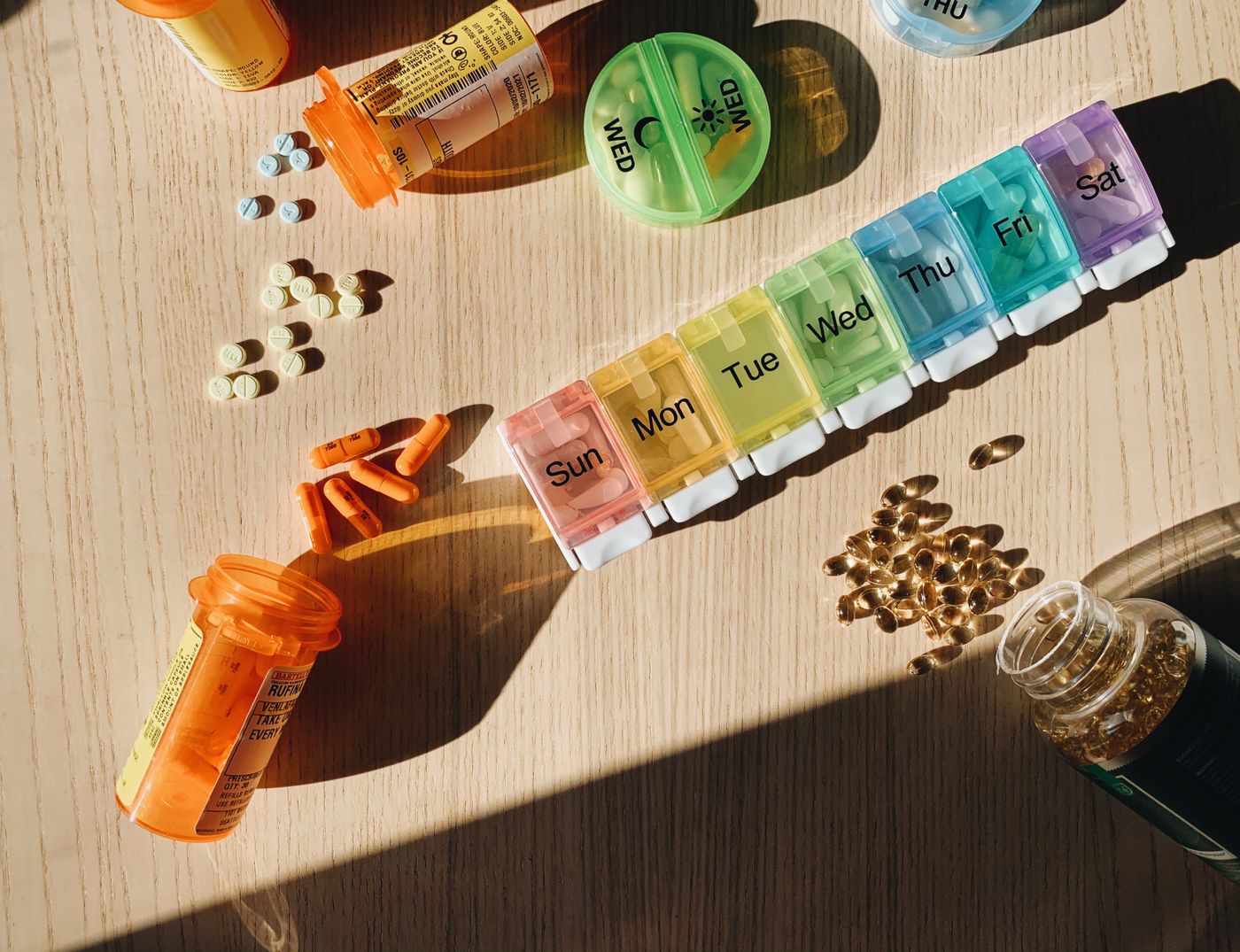
It's the question we field most often at Entegro Health HQ, so let's answer it properly rather than in a sentence.
A healthy gut microbiome holds a diverse array of bacteria from many different groups, and humans have been eating fermented foods for thousands of years. We live in community with these organisms. That's the default position, and it's not a nervous one.
Why does timing matter at all?

Because how a medicine gets into you depends entirely on how it goes in.
An intravenous injection reaches the bloodstream straight away. Intramuscular and subcutaneous injections take longer, absorbing over minutes to hours. A transdermal patch is slower again. Liquids and tablets that dissolve under the tongue get in quickly, bypassing the digestive tract altogether.1
But most medicine taken at home is swallowed. That means it has to travel — through the stomach and into the small intestine, where the majority of oral drug absorption happens.1
Which is also where a probiotic is passing through. Hence the advice to space them out: not because something dramatic happens if you don't, but because two things arriving together in the same stretch of gut is a variable you don't need.
Do
Check with your health care provider
Particularly if you take anything regularly. Your pharmacist is the most accessible expert on interactions and is generally delighted to be asked.
Take it apart from your medication
If your medication is a first-thing-in-the-morning habit, take Flourish in the afternoon or before bed. If you take medication morning and night, go midday.
Pay attention to how you feel
Monitor your response — both to the medication and to the supplement — rather than assuming. You're the only person taking this particular combination.
Don't
Swallow them at the same moment
Same reasoning as above. Give it a couple of hours in either direction and you've removed the question.
Take it alongside an antibiotic dose
Antibiotics are indiscriminate — they'll take out the friendly bacteria as readily as the ones you're treating. Two hours before or after the antibiotic is the practical convention.
Worth saying plainly: that interval is sensible custom rather than a figure established by trial. There's no randomized evidence pinning down two hours specifically. It's a reasonable buffer, not a magic number.
The exception in your own bottle
Here's a detail that applies specifically to Flourish, and it's a good one.
Ten of the eleven strains are bacteria — the Lactobacillus, Bifidobacterium, Enterococcus and Bacillus members of the gang. Those are exactly what an antibacterial antibiotic is built to deal with, so the spacing advice above is for them.
The eleventh is Saccharomyces cerevisiae, and it's a yeast. Antibiotics target structures that bacteria have and fungi don't, which means antibacterial drugs simply don't act on it. That isn't a loophole we invented — a close relative, S. boulardii, is the probiotic most often studied alongside antibiotic courses precisely because it survives them.2,5
So on an antibiotic course you're not losing everything. You're losing some of it, temporarily, and the timing gap protects the rest.
If your immune system is suppressed, ask first — properly
This is the one place we'd rather be blunt than reassuring.
Probiotics are very safe for healthy people. In people who are severely immunocompromised or critically ill, there are documented cases of the organisms themselves causing bloodstream infection — bacteremia, and with yeast-containing products, fungemia. The reported risk concentrates in specific situations: central venous catheters, short bowel syndrome, recent major surgery, and premature infants.3,4
These events are rare. They are also serious enough that "check with your provider" should mean an actual conversation, not a mental note. If you're on immunosuppressants, having chemotherapy, living with a central line, or caring for someone who is — that conversation comes before the first dose.
And if you're on nothing in particular?
Then take it whenever you'll remember, and stop overthinking it. Consistency beats optimization by a distance — a dose you actually take at an imperfect hour is worth more than a perfectly timed one you skip.
We go further into timing in Best Time to Take Probiotics.
Where does Flourish fit?
Flourish Original and Flourish Junior are living liquid probiotics — eleven strains, small-batch fermented in Iowa — taken daily to support digestive and microbiome health.
Flourish is a dietary supplement made to support digestive and microbiome health. It isn't a treatment for any condition and it doesn't replace anything you've been prescribed. Never stop or change a prescribed medication on the basis of a blog post — that decision belongs with the person who wrote the prescription.

Ready to try a living probiotic?
Eleven living strains. One daily shot. For the whole family.
Shop Flourish Original · Shop Flourish Junior · Why we keep it liquid
A few questions we hear a lot
How long should I leave between my medication and Flourish?
A couple of hours in either direction covers it. That interval is practical convention rather than a trial-derived figure — the aim is simply not to have both arriving in the same stretch of gut at once.
Can I take it during a course of antibiotics?
Yes, spaced two hours from each dose. The bacterial strains take a hit from any antibacterial; the Saccharomyces cerevisiae in the blend is a yeast and isn't affected by antibacterial drugs at all.2
Why does a yeast survive antibiotics?
Because antibacterials target structures specific to bacteria, and fungi are built differently. It's the same reason S. boulardii is the probiotic usually studied alongside antibiotic treatment rather than spaced away from it.2
I'm on an immunosuppressant. Can I take a probiotic?
Ask your provider before you start, and treat that as a real conversation. Probiotic organisms have caused bloodstream infections in severely immunocompromised and critically ill patients — rare, but documented, and concentrated in situations like central lines and recent major surgery.3,4
Does the probiotic stop my medication working?
There's no general reason to expect that, and the spacing advice exists to keep it a non-question rather than because something specific is known to go wrong. If you're on a drug with a narrow therapeutic range, your pharmacist is the person to ask.
Should I take it with food?
It's a fermented liquid rather than a capsule, so it's forgiving. Take it at whatever point in the day you'll consistently remember.
About this article
Written by: Lorilyn Van Dyke, Entegro Health | Originally published: March 2021
Important information
This article is for general education and isn't a substitute for professional medical advice, diagnosis, or treatment. Never start, stop or change a prescribed medication without speaking to your health care provider. If you are immunocompromised, critically ill, have a central venous catheter, or are caring for a premature infant, speak to a clinician before giving or taking any probiotic. These statements have not been evaluated by the Food and Drug Administration. This product is not intended to diagnose, treat, cure, or prevent any disease.
Sources
- Le, J. Drug Absorption. StatPearls / NCBI Bookshelf — routes of administration and the small intestine as the principal site of oral drug absorption. Source
- Kelesidis, T., & Pothoulakis, C. (2012). Efficacy and safety of the probiotic Saccharomyces boulardii for the prevention and therapy of gastrointestinal disorders. Therapeutic Advances in Gastroenterology, 5(2), 111–125. Source
- Doron, S., & Snydman, D. R. (2015). Risk and safety of probiotics. Clinical Infectious Diseases, 60(Suppl 2), S129–S134. Source
- Hill, C., Guarner, F., Reid, G., et al. (2014). The International Scientific Association for Probiotics and Prebiotics consensus statement on the scope and appropriate use of the term probiotic. Nature Reviews Gastroenterology & Hepatology, 11, 506–514. Source
- Entegro Health. Proudly Made in the USA — the eleven strains in Flourish, including Saccharomyces cerevisiae. Source