PRO-101: A Brief History of Fermentation & Probiotics
People were fermenting food for thousands of years before anyone could explain why it worked. Here's how we got from bubbling jars to living probiotics — and what most modern probiotics leave behind.

So, what actually is fermentation?
Here's the whole thing in one sentence: bacteria and yeast eat the sugars and starches in food — the natural sugars in milk, grains or vegetables — and turn them into acids or alcohol. As those microbes feed and grow, they leave behind a whole cast of byproducts: organic acids, peptides, bacteriocins and short-chain fatty acids. Those compounds lower the food's pH (which is what keeps it from spoiling) and bring plenty of benefits of their own along the way.2,4
Think of it as a trade. The microbes get a meal; you get a food that lasts longer, tastes more interesting, and is now carrying both living bacteria and the good stuff they made — the compounds we now call postbiotics.
And what makes something a "probiotic"?
Not every ferment is about your health — but adding beneficial bacteria on purpose, for the person eating it, is exactly what a probiotic does. The word comes from the Greek for "for life," and the International Scientific Association for Probiotics and Prebiotics puts it plainly: probiotics are "live microorganisms that, when administered in adequate amounts, confer a health benefit on the host."1 Live being the operative word.
People have been at this for a very long time
Cultures all over the world have leaned on fermentation to preserve and flavor their food for centuries. Some of the earliest evidence takes us back to Egypt and the Middle East as far as 7000 BC — and honestly, once you start looking, fermented foods are everywhere:
- Cheeses
- Kefir
- Kumiss, zabadi, doogh, dahi
- Bread
- Chocolate
- Soy
- Sausages
- Beer
- Wine
It's easy to forget how mysterious this must have seemed. In some cultures, bread rising or wine bubbling away on its own was chalked up to the divine — some unseen force stepping in on humanity's behalf. Which, when you think about it, isn't a bad guess for something you couldn't see.
How we finally figured out what was going on
People were fermenting food for thousands of years before anyone could explain it. The science caught up slowly, one curious person at a time.
In the 1680s, a Dutchman named Antonie van Leeuwenhoek built himself a microscope
— and suddenly you could see the invisible. A draper by trade, he ground better lenses than anyone alive. Some of the first bacteria he ever described came from the plaque on his own teeth, and he was the first person to watch yeast cells fermenting in real time. Sadly he kept the lens-making a closely guarded secret, so after he died much of his work was quietly forgotten.

A century later, the Frenchman Antoine Lavoisier
— often called the father of modern chemistry — was the first to treat fermentation as arithmetic. A man who thought in balance sheets, he weighed everything going into the vat and everything coming back out, then wrote what's generally counted as the first chemical equation: grape must becomes carbonic acid plus alcohol. He called it one of the most extraordinary reactions in all of chemistry. We owe him the word alcohol too, borrowed from Arabic, since the same spirit could be pulled from cider or plain fermented sugar and not just wine. Five years later the Revolution sent him to the guillotine.

Then, in the mid-1800s, Louis Pasteur
connected it all. Being a biologist as much as a chemist, he didn't look at bacteria in isolation. He worked out that the microbes were doing the work themselves, and famously described fermentation as "life without air."4 He also handed us pasteurization, after finding that heating food and drink to 60–100°C kills the bacteria and mould present. He patented it in 1865 and it spread fast. (Which is also why a lot of "fermented" food on shelves today contains nothing live — more on that shortly.)

From folk wisdom to "functional food"
People sensed the link between fermented food and feeling good long before they could prove it. Ancient healers prescribed fermented foods and drinks for all sorts of ailments. The line most often attributed to Hippocrates — that all disease begins in the gut — has been repeated for more than 2,000 years. Whoever said it first wasn't wrong about how central the gut is.
The modern version of that idea arrived in 1907, with a Russian scientist named Élie Metchnikoff.3 He noticed that a rural Bulgarian population was living remarkably long lives, and tied it to how much fermented milk — yogurt and kefir — they ate. He was the first to suggest that the intestinal microbes depend on what we feed them, and that we might therefore swap the harmful ones out for useful ones on purpose.4 That's essentially the first modern definition of a probiotic, and it made fermented milk the original "functional food."2,4
Why we drifted away from it (and found our way back)
Somewhere along the line, "progress" nudged us away from how our ancestors ate. When people lived off the land, the seasons decided the menu — and preserving food was simply how you made it through the lean months. (Anyone who's spent a winter in Iowa gets the instinct.) But as we settled down and life got more convenient, a lot of that fermented diversity quietly slipped out of our diets. The art of cheese-making was even lost for a stretch during the high middle ages — before monks, bless them, revived it. Those same monks, by the way, get a good deal of the credit for keeping fermentation alive in the beer world too.
Probiotics as a supplement really got going in the early 1930s, when the Japanese scientist Dr Minoru Shirota cultivated a strain of Lactobacillus casei, figured out how to grow it in milk, and started handing out little bottles of it — all with the simple goal of helping people feel better.5 Sound familiar?
How most probiotics are made today — and how we do it differently
These days, the most common way to get a probiotic into a capsule looks like this:
- Grow the bacteria in a liquid
- Spin that liquid in a centrifuge to pull the bacteria out, away from the medium they grew in
- Freeze-dry them into a powder
- Pack the powder into a capsule
It works, and it makes for a tidy, shelf-stable pill. But it also puts the bacteria to sleep — and it tends to leave behind the liquid they grew in, along with a lot of the good compounds they made while they were in there.

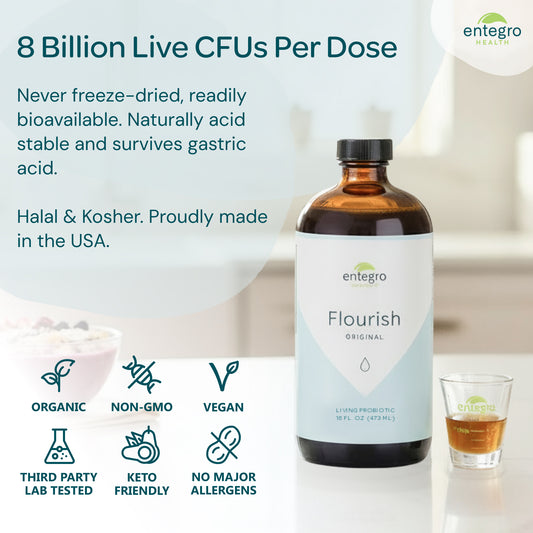
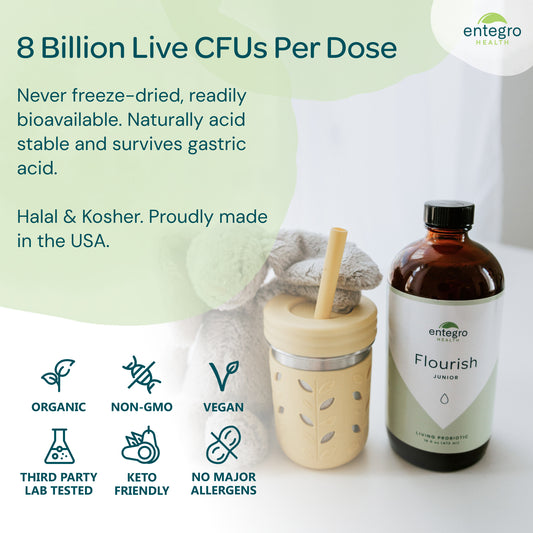
We took a different road. At Entegro Health, we like to keep our bacteria in the state they're happiest in: alive, in liquid. We keep the bacteria, the medium they grew in, and all those beneficial metabolites together in one living bottle. The eleven strains in Flourish Original were chosen because they get along and grow well side by side — think of them less as ingredients and more as a well-matched support group. It's a small, old-fashioned way of doing things, and we're genuinely proud to be part of a tradition this ancient.
Flourish is a dietary supplement made to support digestive and microbiome health. It isn't a treatment for any condition.
You don't have to choose between food and a bottle
Fermented foods and a daily probiotic aren't rivals — most people are better off with both. If you want to start eating more of them, here's where to begin. Feeling adventurous? Our home-fermented ketchup actually uses Flourish as the live starter culture, which is a fun way to see fermentation happen on your own counter. And if you're curious about those byproducts we mentioned, postbiotics get their own explainer here.

Ready to try a living probiotic?
Eleven living strains. One daily shot. For the whole family.
Shop Flourish Original · Shop Flourish Junior · Why we keep it liquid
A few questions we hear a lot
What is fermentation, in plain English?
It's when microbes like bacteria and yeast eat the sugars in food and turn them into acids or alcohol — preserving the food and creating helpful compounds in the process.
Who "discovered" fermentation?
No one person, really. Humans were fermenting food for thousands of years before the science existed. Van Leeuwenhoek first saw the microbes in the 1680s, Lavoisier explained the chemistry in the late 1700s, and Pasteur proved microbes were behind it in the mid-1800s.
Are all fermented foods actually probiotic?
Not necessarily. A lot of them are heated or baked after fermenting, which kills off the live cultures. Look for "live" or "active cultures" on the label — and check the refrigerated section, since that's usually where the living ones live.
Is Flourish fermented?
It is. Flourish is fermented in small batches and bottled as a living liquid instead of being freeze-dried, so the bacteria and everything they made during fermentation stay together in the bottle.
About this article
Written by: Lynn | Originally published: 2019
Important information
This article is for general education and isn't a substitute for professional medical advice, diagnosis, or treatment. Always talk to your physician or another qualified health provider about any questions regarding a medical condition. These statements have not been evaluated by the Food and Drug Administration. This product is not intended to diagnose, treat, cure, or prevent any disease.
Sources
- Goldin, B. R. (1998). Health benefits of probiotics. British Journal of Nutrition, 80(S2), S203–S207. Source
- Fu, R. H., Wu, D. C., Yang, W., Scoffield, J., & Benveniste, E. N. (2017). Probiotic Metabolites Promote Anti-inflammatory Functions of Immune Cells [Abstract]. FASEB Journal. Source
- Gasbarrini, G., Bonvicini, F., & Gramenzi, A. (2016). Probiotics History. Journal of Clinical Gastroenterology, 50, S116–S119. Source
- Islam, S. U. (2016). Clinical Uses of Probiotics. Medicine, 95(5), e2658. Source
- Contributing to the health and happiness of people around the world. (n.d.). Yakult. Source
- International Scientific Association for Probiotics and Prebiotics (ISAPP). Definition of probiotics. Source