Home Ferment Ketchup - Try it!
Kids and ketchup. They just go together. This is the version I wish I'd known about years ago — same magic red sauce, minus the corn syrup, plus a few days of fermentation doing the interesting work.

At least it went that way at my house, back when my girls were picky eaters. Don't like that steak? Give this magic red sauce a try. Green beans are a no today? Get out the special sauce.
It worked every time, and I made my peace with it. What I'd have liked is a version that wasn't mostly sugar.
What fermenting actually does here
You're not preserving the tomato paste — it's already shelf-stable. You're adding live bacteria and letting them work for a few days, which builds acidity, deepens the flavor into something tangier and more savoury, and leaves you with a condiment carrying live cultures instead of high-fructose corn syrup.
The trade is a sauce that tastes noticeably more grown-up than the squeeze bottle. Which is either a feature or a problem, depending on the child. More on that in a moment.
Is fermenting on the counter safe?
Fair question, and worth answering properly rather than waving it off.
The safety mechanism in any ferment is acidity. Below pH 4.6, Clostridium botulinum can't produce toxin, and most other pathogens can't survive either.1,2 In a typical vegetable ferment there's a window of a day or two at the start while the bacteria are still building that acid.
This recipe doesn't have that window. Tomato paste already sits around pH 4.1–4.5 before you touch it, and three tablespoons of vinegar pushes it lower still — finished ketchup lands near pH 3.9.3,4 You're starting below the threshold rather than racing toward it.
That makes this one of the more forgiving ferments to try first. Which is exactly why it's a good one to start with.
About that starter
You need something alive to get this going. Three options work:
- Flourish Original — what I use. Eleven strains from five families, and I know for certain it's alive.
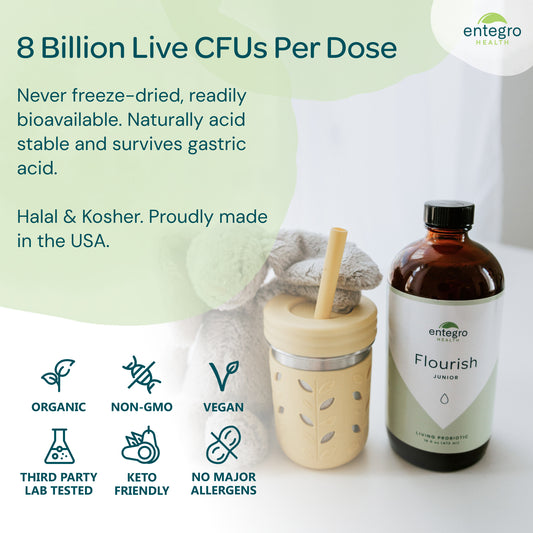
- Flourish Junior — also works well and gives a sweeter tang. Same probiotic, sorghum base instead of molasses. It's a flavor difference, not an age one.
- Whey from yogurt, or brine from another live ferment — both fine.
The one that won't work
Brine from most shelf-stable commercial sauerkraut. It's been pasteurized, which is the whole point of putting it on a shelf — and it means there's nothing alive left in the jar to start your ferment.
If you're raiding a jar of kraut for brine, take it from the refrigerated section and check the label says raw or live.

The recipe
Home Ferment Ketchup
Ingredients
- 18 oz tomato paste (three 6 oz cans)
- ¼ cup Flourish Original or Junior, or whey, or brine from a live ferment
- 3 Tbsp raw apple cider vinegar
- 1–2 Tbsp honey or maple syrup
- 1 tsp kosher or sea salt
- 1 tsp garlic powder
- ½ tsp mustard powder
- ¼ tsp ground allspice
- Optional: ¼ tsp fish sauce, or a few shakes of Tabasco
Instructions
- Combine everything in a bowl and stir until smooth. Use glass or ceramic rather than metal — this is an acidic mix and it will sit for days.
- Move it into a quart jar. Leave an inch or so of headroom, and rest the lid on loosely rather than screwing it down. Fermentation produces carbon dioxide and it needs somewhere to go.
- Leave the jar somewhere cool and dark for 3–4 days. Room temperature is fine; around 70°F is the sweet spot. Give it a stir once a day.
- Taste it from day two. When the tang is where you want it, screw the lid down and move it to the fridge.
- Keeps three to six months refrigerated — if it lasts that long.
Swap the spices freely. This recipe is forgiving enough that you can work with whatever's in your pantry. Onion powder, a pinch of clove, smoked paprika — all good. The tomato paste, the starter and the vinegar are the parts doing structural work; everything else is seasoning.
Signs it's going well: a little bubbling, a smell that's sour and bright rather than off. Signs to stop: fuzzy or colored mould on the surface, or anything genuinely putrid. A flat white film is usually harmless kahm yeast — skim it. Fuzzy and colored means start again.2
Get the kids in on it
So much science and life learning happens in a kitchen, and this one is a genuinely good demonstration — you can watch the bubbles arrive.
There's also a practical reason. Having your kids help makes the flavor transition from bottled ketchup to this version go a great deal smoother. They take some pride in the work they've put in, and they're far more likely to give it an honest try.

Be straight with them about the taste, though. This is tangier and less sweet than what comes out of a squeeze bottle, and pretending otherwise gets you one suspicious bite and a hard no. Start with a batch on the sweeter end — the full 2 tablespoons of honey, and Junior as the starter — then dial it back over time as everyone adjusts.
One safety note on the honey
Honey shouldn't be given to children under 12 months, in any form, because of the risk of infant botulism — and this ferment never gets heated, so nothing removes that risk.5 Use maple syrup instead if there's a baby in the house.
Why Flourish makes a good starter
Most starters give you whatever happened to be in that yogurt or that jar of kraut. Flourish gives you eleven strains from five families, small-batch fermented and bottled alive in liquid rather than freeze-dried — so you know what's going in, and you know it's awake.

It also means you're not opening a separate product just for the recipe. A quarter cup goes into the ketchup; the rest of the bottle carries on being your daily shot.
Flourish is a dietary supplement made to support digestive and microbiome health. It isn't a treatment for any condition. Home fermentation carries its own risks — follow the recipe, use clean equipment, and discard anything that looks or smells wrong. Check with your doctor before starting a new supplement, and with your pediatrician before giving one to a child.
What to put it on
Everything you'd use ketchup on, which in my house was and remains "most things." Fries, burgers, eggs, meatloaf, and whatever vegetable is currently being negotiated over.

If this is your first ferment and you'd like to know what's actually happening in that jar, we wrote a short history of fermentation that covers the science without getting heavy about it. And if you'd rather start by eating fermented food than making it, here's where to begin.

Ready to try a living probiotic?
Eleven living strains. One daily shot. For the whole family.
Shop Flourish Original · Shop Flourish Junior · Why we keep it liquid
A few questions we hear a lot
Is it safe to ferment ketchup on the counter?
Yes, for this recipe. Fermentation safety depends on the mixture being below pH 4.6, and tomato paste plus vinegar puts you there before fermentation even starts.1,3,4 Use clean equipment, keep the lid loose, and discard the batch if you see fuzzy or colored mould.
Why can't I use brine from the sauerkraut in my pantry?
Because shelf-stable kraut has been pasteurized, and pasteurization is what makes it shelf-stable. There's nothing alive in it to start your ferment. Refrigerated raw kraut is a different story.
Can I skip the starter altogether?
You'd be relying on whatever wild bacteria are present, and tomato paste from a can doesn't have many. If you want live cultures in the finished ketchup, the starter isn't optional.
Does the fermented version taste like normal ketchup?
No, and it's better to say so upfront. It's tangier, more savoury and much less sweet. Most people come round to it quickly; children take a little longer. Make the first batch sweeter and work down.
How long does it keep?
Three to six months in the fridge. It will keep slowly fermenting in there, so the flavor continues to develop.
Why does the lid need to be loose?
Fermentation makes carbon dioxide. A tightly sealed jar has nowhere to vent it, which builds pressure. Loose lid, or a proper airlock if you have one.
Can I use Flourish Junior instead of Original?
Absolutely, and it gives a sweeter tang that tends to go down better with children. They're the same probiotic — Junior just ferments on sorghum rather than molasses.
About this article
Written by: Lorilyn Van Dyke, Entegro Health | Originally published: April 2020
Important information
This article is for general education and isn't a substitute for professional medical advice, diagnosis, or treatment. Talk to your physician or another qualified health provider about any questions regarding a medical condition, and before starting a new supplement — including for a child. These statements have not been evaluated by the Food and Drug Administration. This product is not intended to diagnose, treat, cure, or prevent any disease.
Sources
- Virginia Cooperative Extension. Making Safe Fermented Foods and Beverages. Source
- BC Centre for Disease Control. Fermented Foods Guidance — Fermented Vegetables. Source
- FoodCrumbles. The Science of Tomato Ketchup (And How It's Made). Source
- Effect of acidity, pH and TSS of tomato ketchup samples during storage. Source
- Centers for Disease Control and Prevention. Foods and Drinks to Avoid or Limit — Infant and Toddler Nutrition. Source