Consuming Fermented Foods
Sauerkraut, kimchi, kombucha, miso, kefir. Western diets have quietly dropped nearly all of them — and the evidence for putting them back is better than most people realize.

Every culture that had to keep food edible without a refrigerator arrived at fermentation independently. Then refrigerators arrived, and most of us stopped. If you want the long version of that story, we wrote a short history of fermentation.
What's interesting is what the research has done in the last few years — because it's rather better news for the cabbage than we expected.
The study that changed the conversation
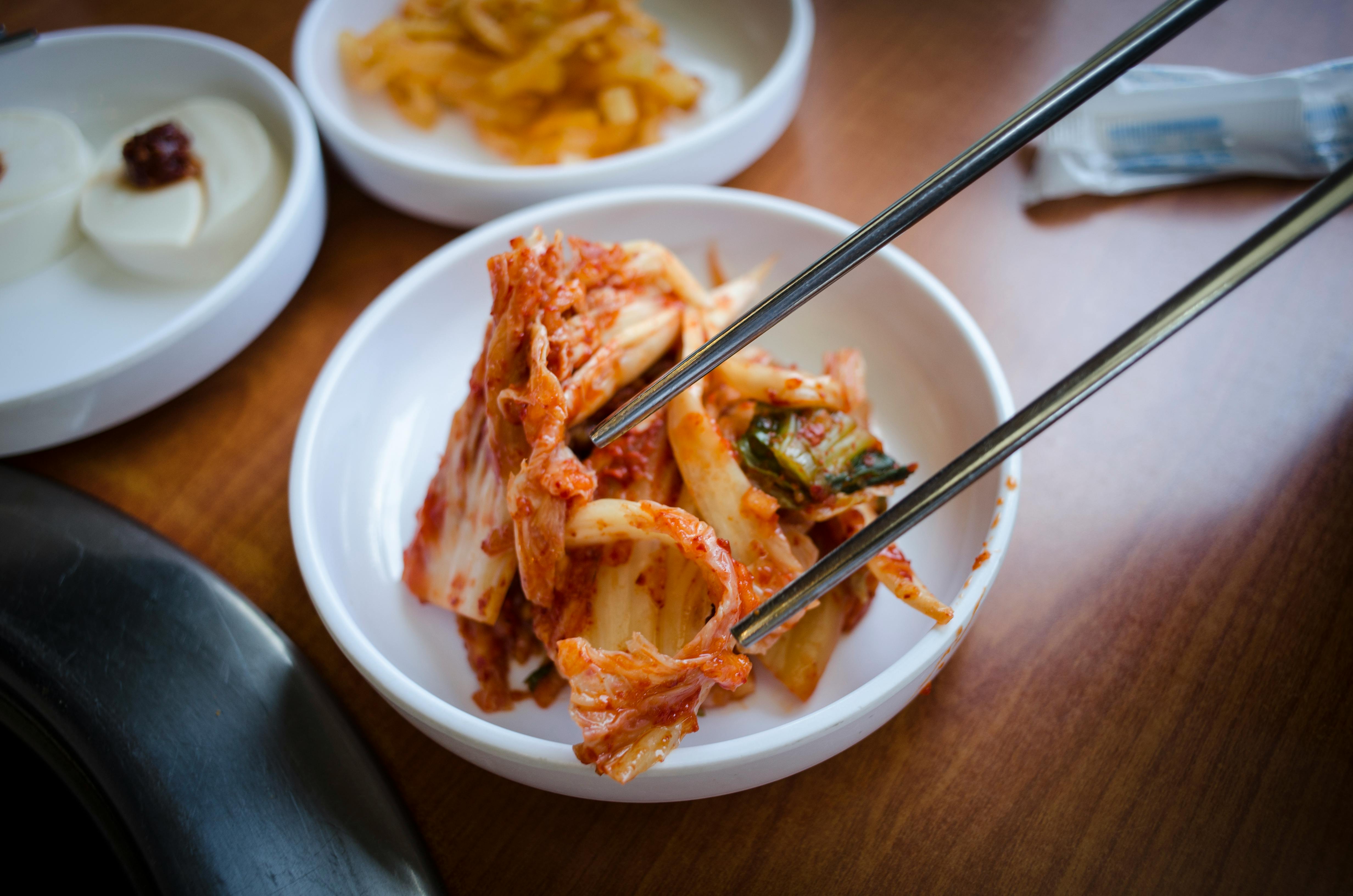
In 2021, Stanford researchers ran a ten-week randomized trial with 36 healthy adults. One group ate a high-fermented-food diet: yogurt, kefir, fermented cottage cheese, kimchi and other fermented vegetables, vegetable brine drinks, kombucha. The other ate a high-fiber diet — legumes, seeds, whole grains, nuts, vegetables, fruit.1
The fermented-food group showed a measurable increase in gut microbiome diversity, with bigger servings producing bigger effects. Nineteen inflammatory proteins measured in blood went down, including interleukin-6. Four types of immune cell showed less activation.1,2
The high-fiber group? Diversity stayed flat, and none of those nineteen proteins dropped. One of the senior authors said plainly that they'd expected fiber to be the more universally beneficial of the two, and it wasn't — at least not over ten weeks.2
That's a genuinely surprising result, and it's the strongest human evidence we have that eating fermented food does something measurable. Not a mouse study. Not a mechanism paper. A controlled trial in people.
One honest wrinkle
When the researchers checked whether the new bacteria in participants' guts had come from the food itself, mostly they hadn't. Something about the fermented-food diet made room for microbes that came from elsewhere, and nobody has fully explained how.3
Which is a good reminder that "eat fermented food, get those exact bacteria" is not what's happening. Something more interesting is.
A note on the word "probiotic"
Fermented foods contain live microbes. That's not the same as containing probiotics. A probiotic is a defined strain, in a known quantity, shown to confer a health benefit. Most sauerkraut has never been characterized to that standard — nobody knows precisely which strains are in that jar or how many.4
ISAPP is direct about it: reserve "probiotic" for strains that have actually met the bar, and marketers should stop applying it to products that haven't.5 Fair enough. That includes us.
It doesn't make fermented food less worth eating. The Stanford trial didn't need defined strains to get its result.
How much is actually in a jar of sauerkraut?
Here's where a lot of articles give you neat numbers. The honest answer is less satisfying.
The honest answer is that nobody can tell you with confidence, because it varies enormously. A survey of the published measurements found lactic acid bacteria in sauerkraut ranging from about 10³ to 10⁸ CFU per gram.6 That's a hundred-thousand-fold spread between the low end and the high end.

Roughly, from the survey data:
- Fermented dairy — yogurt, kefir: typically 10⁷–10⁹ CFU/g7
- Kimchi: generally 10⁷–10⁸ CFU/g6,7
- Sauerkraut: anywhere from 10³ to 10⁸ CFU/g6
- Flourish: a minimum of 8 billion CFU per tablespoon, from eleven strains across five families
Three things drive that variability: whether the product was pasteurized, how old it is, and how it's been stored. Shelf-stable sauerkraut from the middle aisle has usually been heat-treated, which is the point of it being shelf-stable — and which means the live count is essentially zero.
The practical rule: buy fermented food from the refrigerated section, and look for "live" or "active cultures" on the label. That single habit matters more than any number in the table above.
So what does a supplement actually add?
Three things, honestly stated.
A known quantity. The label tells you what's in it. A jar of kraut doesn't.
Consistency. Same dose today as last Tuesday. Fermented food is wonderful and wildly variable.
Convenience. Six servings of fermented food a day — roughly what the Stanford high-fermented group worked up to — is a genuine lifestyle change. A tablespoon is a tablespoon.

What a supplement does not do is replace the food. The trial that produced those results used food, not capsules, and we're not going to pretend otherwise on a page about fermented foods.
The answer is both, and it isn't a cop-out
Fermented foods bring variety, fiber, the food matrix, and — per Stanford — a measurable effect on diversity and inflammatory markers. A living liquid probiotic brings a known dose of defined strains, every day, without a shopping trip.
They're doing different jobs. Most people are better off with both than with a strong opinion about either.

Flourish Original and Flourish Junior are small-batch fermented and bottled alive rather than freeze-dried, so the compounds the bacteria produced during fermentation stay in the bottle. Original ferments on molasses and tastes stout; Junior ferments on sorghum and tastes sweet. Same probiotic — a flavor choice, not an age one.
Flourish is a dietary supplement made to support digestive and microbiome health. It isn't a treatment for any condition. If you're managing a gut condition, that's a conversation with your doctor. Check with them before starting a new supplement, and with your pediatrician before giving one to a child.
Where to start, if you're starting
Don't overhaul anything. Pick one thing you'll actually eat.
- Yogurt or kefir with breakfast — the easiest entry point by a distance
- A forkful of kimchi or sauerkraut alongside dinner, from the fridge section
- Miso in a soup or dressing, added off the heat so it stays live
- Kombucha instead of the afternoon soft drink
Aim for variety over volume. Different ferments carry different microbes, and the evidence points toward a range rather than six jars of the same thing. If you'd like to make your own, our home-fermented ketchup is about as forgiving a first project as exists.

Ready to try a living probiotic?
Eleven living strains. One daily shot. For the whole family.
Shop Flourish Original · Shop Flourish Junior · Why we keep it liquid
The short version
- Fermented foods have real human evidence behind them — a ten-week trial found increased microbiome diversity and lower inflammatory markers.1
- Live microbes aren't automatically probiotics. Probiotic means defined strains with demonstrated benefit.
- The amount in any given jar varies hugely and usually isn't measured. Buy refrigerated, look for live cultures.
- A supplement adds a known, consistent dose — not a replacement for the food.
A few questions we hear a lot
Can I get enough from fermented foods alone?
Depends what you mean by enough. If you mean a measurable effect on your microbiome, the Stanford trial suggests yes — with roughly six servings a day, which is a lot. If you mean a specific, known dose of specific strains, no: fermented foods aren't standardized and mostly aren't measured.1,6
Is shelf-stable sauerkraut still good for me?
It's still food, and it still has fiber. But if it's shelf-stable it's almost certainly pasteurized, which means the live cultures are gone. For live microbes, buy from the refrigerated section.
Do I need both fermented foods and a supplement?
Need is a strong word. They do different jobs — food brings variety and the whole food matrix, a supplement brings a consistent known dose. Plenty of people do fine with one or the other.
Why is kombucha sometimes listed as a probiotic and sometimes not?
Because "probiotic" has a technical meaning most fermented drinks don't meet. Kombucha contains live microbes; whether any specific strain in it has been shown to confer a health benefit is a separate question.5
Will fermented foods help my IBS?
That's a question for your doctor, not a blog. Some fermented foods are high in FODMAPs and can make symptoms worse for some people. We're not in a position to advise on a diagnosed condition.
How do I start without upsetting my stomach?
Small amounts, one food at a time, and give it a week or two. A forkful of sauerkraut is a reasonable first step. A whole jar is not.
About this article
Written by: Kelsy Armstrong, Entegro Health | Originally published: February 2025
Important information
This article is for general education and isn't a substitute for professional medical advice, diagnosis, or treatment. Always seek the advice of your physician or another qualified health provider with any questions regarding a medical condition, and before starting a new supplement. These statements have not been evaluated by the Food and Drug Administration. This product is not intended to diagnose, treat, cure, or prevent any disease.
Sources
- Wastyk, H. C., Fragiadakis, G. K., Perelman, D., et al. (2021). Gut-microbiota-targeted diets modulate human immune status. Cell, 184(16), 4137–4153. Source
- Stanford Medicine. Fermented-food diet increases microbiome diversity, decreases inflammatory proteins, study finds. Source
- Gut Microbiota for Health. Fermented foods show potential in increasing gut microbial diversity and modulating immune responses. Source
- Marco, M. L., Sanders, M. E., Gänzle, M., et al. (2021). ISAPP consensus statement on fermented foods. Nature Reviews Gastroenterology & Hepatology, 18, 196–208. Source
- International Scientific Association for Probiotics and Prebiotics. Do fermented foods contain probiotics? Source
- Rezac, S., Kok, C. R., Heermann, M., & Hutkins, R. (2018). Fermented Foods as a Dietary Source of Live Organisms. Frontiers in Microbiology, 9, 1785. Source
- Marco, M. L., et al. (2022). A Classification System for Defining and Estimating Dietary Intake of Live Microbes in US Adults and Children. The Journal of Nutrition. Source