Cocoa Covered Granola
Chocolate for breakfast, and nobody has to feel weird about it. This one is built on oats and pecans, which means most of the fiber in it is the kind your gut bacteria can actually eat.

Granola has a bit of a reputation problem. It sounds virtuous, and then you read the label and find something closer to a crumbled cookie.
Making it yourself fixes that, mostly because you decide how much honey goes in. This version is cocoa-heavy, barely sweet, and takes about five minutes of actual work before the oven does the rest.
What's actually good for you in here
The oats are doing the heavy lifting, and not for the reason people usually assume.
Oats are rich in beta-glucan, a soluble fiber that your own digestive enzymes can't break down. It travels intact to the colon, where your resident bacteria ferment it into short-chain fatty acids — acetate, propionate, butyrate — the compounds the cells lining your gut use as fuel.1,2 That's the fiber that feeds bacteria. Not all fiber does this job.
A small practical bonus: oat fiber ferments more slowly than inulin, which means less gas for the same benefit.3 If chicory-root fiber bars have ever betrayed you at work, oats are the gentler road.

The pecans add close to three grams of fiber an ounce plus their own polyphenols, and they're one of the more studied nuts for gut microbiota effects.4
And the cocoa? Genuinely interesting, and genuinely unsettled
Cocoa flavanols are poorly absorbed in the small intestine, so most of them arrive in the colon more or less intact — which puts them in front of your bacteria.5
A 2011 randomized crossover trial found that four weeks of a high-flavanol cocoa drink significantly increased bifidobacteria and lactobacilli and decreased clostridia.6 That's the study everyone quotes, and it's a good one.
Here's the part most blogs leave out. A later randomized, placebo-controlled crossover trial using a high daily dose found no difference in Bifidobacterium or Lactobacillus abundance at all.7 The authors were direct about it: the evidence is inconsistent, and nobody has pinned down the dose or duration needed.
So cocoa is a plausible prebiotic, not a proven one. We'd rather tell you that than sell you a slogan. Eat it because it's delicious and it makes the oats disappear faster.
One tip that actually changes the numbers
If flavanols are why you're here, the type of cocoa matters more than the amount.
Alkalizing cocoa — "Dutch process," or "processed with alkali" on the label — is what makes it dark and mellow, and it strips flavanols in the process. One survey of commercial powders measured natural cocoa at about 34.6 mg of total flavanols per gram, lightly processed at 13.8, medium at 7.8, and heavily processed at 3.9.8 That's roughly a ninth of what you started with.
The recipe calls for dark cocoa, which is almost always Dutched. Use it if you want that near-black color and rounder flavor. Swap in natural cocoa if you want the flavanols — it'll be lighter and a little sharper, and honestly quite good.
The recipe
Cocoa Covered Granola
Ingredients
- 6 cups old-fashioned oats
- 2 cups pecans, halved or lightly chopped
- 6 tablespoons dark cocoa powder
- ¼ cup coconut oil
- ½ cup honey
- 2 teaspoons vanilla
Instructions
- Heat the oven to 300°F.
- Stir the oats and pecans together in a roasting pan or deep sheet tray.
- Warm the honey and coconut oil on the stovetop or in the microwave, then whisk.
- Sift the cocoa powder into the honey and oil and whisk until smooth. Add the vanilla and whisk again. Sifting isn't fussiness — cocoa clumps, and the lumps don't break up later.
- Pour the honey mixture over the oats and pecans and stir until evenly coated.
- Bake 40 minutes, stirring every 10. The stirring is what keeps the edges from scorching while the middle is still pale.
- Let it cool completely before you touch it. Granola crisps as it cools, not in the oven — pull it out soft and it stays soft.

Make it yours. Chocolate chunks, fresh or freeze-dried strawberries, unsweetened or toasted coconut flakes, hemp seeds, pepitas — really any of your favourite fruits, nuts and seeds. Add anything dried or delicate after baking, not before, or it'll turn to dust.
The honey is the dial. Half a cup across eight cups of granola is already restrained; take it to a third of a cup and you'll get something closer to a dark chocolate biscuit, in the good way.

Two things worth knowing before you bake
Honey and babies don't mix. The CDC advises no honey in any form before 12 months, because of the risk of infant botulism.9 And baking doesn't solve it — the spores survive oven heat.10 So this granola is for the over-ones. Maple syrup swaps in cleanly if you need a version for a younger sibling.
Don't bake Flourish into it. We've been asked. Flourish is a living liquid, and 300°F for forty minutes is exactly how you'd kill it. Pour the granola, then take the probiotic alongside — that's the whole point of pairing fermentable fiber with live bacteria rather than cooking them together.
What to eat it with
Milk or a milk alternative, your favourite yogurt, or straight out of the jar by the handful. We're not going to pretend the third one doesn't happen.

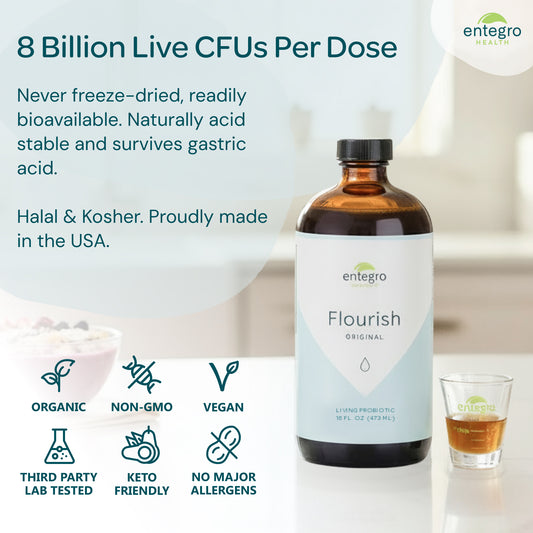
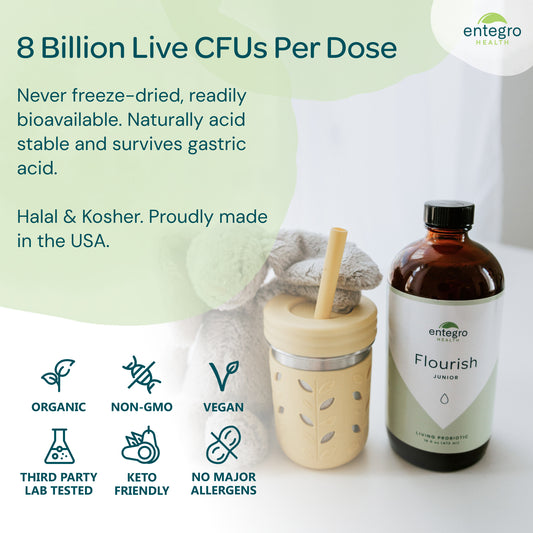
If you want the full breakfast: fermentable fiber on the plate, and a shot of Flourish Original or Flourish Junior next to it. Eleven living strains from five families, small-batch fermented, kept alive in liquid rather than freeze-dried.

Worth clearing up, since the name confuses people: Original and Junior are the same probiotic. Same strains, same process, same third-party testing. Original ferments on molasses and tastes stout; Junior ferments on sorghum and tastes sweet, a bit like apple cider. It's a taste decision, not an age one.
Flourish is a dietary supplement made to support digestive and microbiome health. It isn't a treatment for any condition.
Hungry for more fiber ideas? We rounded up ten high-fiber foods worth keeping in the house, and there's a smoothie bowl this granola sits on top of very nicely.

Ready to try a living probiotic?
Eleven living strains. One daily shot. For the whole family.
Shop Flourish Original · Shop Flourish Junior · Why we keep it liquid
A few questions we hear a lot
How long does homemade granola keep?
About two weeks in an airtight container at room temperature, longer in the freezer. The enemy is moisture, so let it cool completely before it goes in the jar — trapped steam is what turns a crisp batch chewy overnight.
Why isn't my granola crunchy?
Almost always because it was moved while warm. Granola sets as it cools. Leave the tray alone until it's at room temperature, then break it up.
Is cocoa actually good for your gut?
The honest answer is that it might be. Cocoa flavanols reach the colon largely unabsorbed and one trial found they increased beneficial bacteria, but a later trial found no effect. The evidence is genuinely mixed.6,7
Can I put Flourish in the granola?
Please don't. It's a living liquid, and baking kills the bacteria. Take it alongside your breakfast instead.
Can I make this without honey?
Yes. Maple syrup is the straightforward swap and behaves almost identically. You'll want that version anyway if anyone under twelve months is in the house.9
Are oats gluten-free?
Oats themselves are, but they're routinely processed alongside wheat. If gluten matters in your house, buy oats labeled certified gluten-free.
About this article
Written by: Lynn | Originally published: March 2020 | Last reviewed: August 2026
Important information
This article is for general education and isn't a substitute for professional medical advice, diagnosis, or treatment. Always talk to your physician or another qualified health provider about any questions regarding a medical condition, and before starting a new supplement — including for a child. These statements have not been evaluated by the Food and Drug Administration. This product is not intended to diagnose, treat, cure, or prevent any disease.
Sources
- Mechanistic insights into beta-glucans and gut microbiota interactions for enhancing human health. (2025). Discover Food. Source
- A critical review on the impacts of beta-glucans on gut microbiota and human health. (2025). ScienceDirect. Source
- Effects of Oats and beta-Glucan on Gut Health. (2014). University of Minnesota. Source
- Pecans and Health: Evidence from Clinical Studies. (2025). News-Medical. Source
- Cocoa Polyphenols and Gut Microbiota Interplay: Bioavailability, Prebiotic Effect, and Impact on Human Health. (2020). Nutrients, 12(7), 1908. Source
- Tzounis, X., Rodriguez-Mateos, A., Vulevic, J., Gibson, G. R., Kwik-Uribe, C., & Spencer, J. P. E. (2011). Prebiotic evaluation of cocoa-derived flavanols in healthy humans: a randomized, controlled, double-blind, crossover intervention study. American Journal of Clinical Nutrition. Source
- Effects of short-term, high-dose cocoa-derived flavanol supplementation on gut microbiota composition: secondary findings from a randomized, double-blind, placebo-controlled crossover study. (2025). Source
- Miller, K. B., Hurst, W. J., Payne, M. J., et al. (2008). Impact of Alkalization on the Antioxidant and Flavanol Content of Commercial Cocoa Powders. Journal of Agricultural and Food Chemistry, 56(18). Source
- Centers for Disease Control and Prevention. Foods and Drinks to Avoid or Limit — Infant and Toddler Nutrition. Source
- What's the buzz? Infants and Honey. (2025). UC Master Food Preserver Program. Source