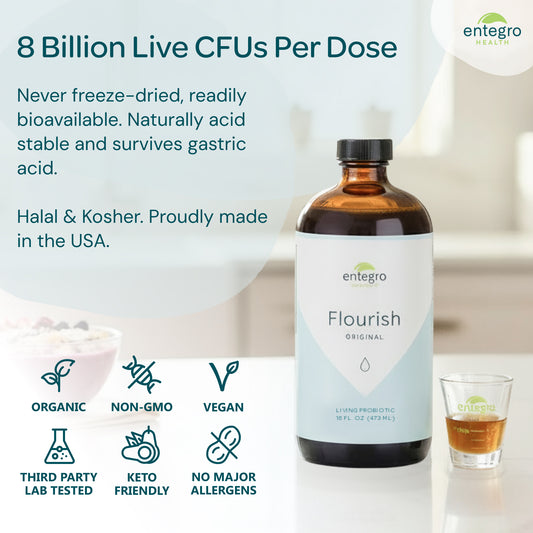
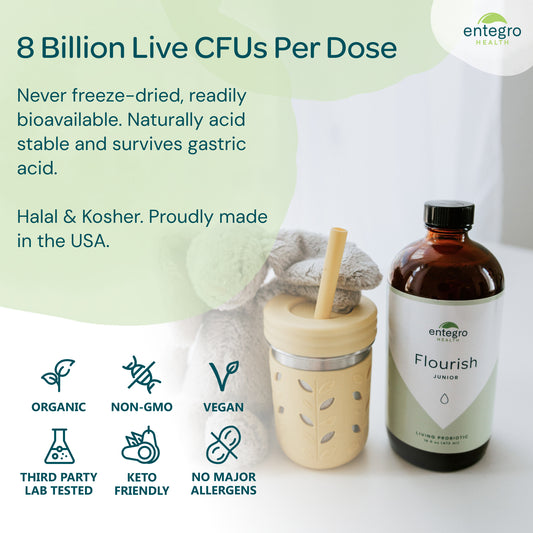
Flourish Probiotics and Postbiotics
Flourish is never freeze-dried, which means the cultures keep working right up until you open the bottle. So what exactly are they making in there?

Photo: Sami Abdullah/ https://www.pexels.com
Most probiotics arrive as a powder. The bacteria were grown somewhere else, dried into dormancy, and packed into a capsule to wait. Flourish takes the other road: the cultures stay in the liquid they grew in, alive and metabolically busy, from fermentation to the moment you pour a tablespoon.
Which raises a fair question. If the bacteria have been fermenting in that bottle, the liquid is not just a delivery vehicle — it is the medium they built. What is in it?
This article is about research, not treatment. Flourish is a dietary supplement, not a medicine. Nothing here is intended to diagnose, treat, cure or prevent any condition. If you have a health concern, please speak to your doctor.
First, the word
You will see products like this described as containing postbiotics, and the usual definition offered is a tidy one: probiotics are the bacteria, prebiotics are what feeds them, postbiotics are what they produce.
That is not the definition the field settled on. In 2021 the International Scientific Association for Probiotics and Prebiotics convened a panel and defined a postbiotic as a “preparation of inanimate microorganisms and/or their components that confers a health benefit on the host.”1 Three words there do a lot of work. Inanimate means the organisms were alive and have been deliberately killed. Preparation means the cells or their fragments have to be present, not just the compounds they made. And confers a health benefit means it has to have been demonstrated in a controlled trial. The statement goes further and names lactic acid and short-chain fatty acids among the purified compounds that, on their own, fall outside the definition.1
So what does Flourish contain?
Fermentation metabolites. The cultures in Flourish are alive, so under the 2021 definition the product does not contain postbiotics — that category requires inactivated cells. What it does contain are the compounds eleven live cultures make while growing: organic acids, enzymes, peptides, amino acids and vitamins. Under the looser definition most of the internet uses, people call those postbiotics. We call them fermentation metabolites, because that is what they are.1
We took the long way round on this in our article on postbiotics, including why two groups of researchers still disagree about where the line belongs.
How the compounds get there
Fermentation is not a step that happens to Flourish. It is what Flourish is. Eleven cultures from five genera — Lactobacillus, Bifidobacterium, Enterococcus, Bacillus and Saccharomyces — are grown together on non-GMO sugarcane molasses or sweet sorghum. They metabolize the sugars, and the products of that metabolism stay in the bottle with them.
This is ordinary food science, and it is the same reason sauerkraut tastes different from cabbage and yogurt tastes different from milk. The consensus statement on fermented foods describes exactly this: microbial growth converts food components into new compounds, and the finished food is chemically different from what went in.2
Freeze-drying stops the process. Staying liquid does not.
Three of those compounds turn up often enough to be worth a close look: lactic acid, acetic acid and the B vitamins. All three are real, all three are measurable, and all three have a more interesting story than the shorthand version.
Lactic acid
The one the whole category is named after. Lactobacillus is called that because it makes lactic acid, and if Flourish tastes tart, this is a large part of why.
What lactic acid genuinely does
In your colon, bacteria ferment the fiber you did not digest and produce acid — a lot of it. The total runs to roughly 400 to 600 millimoles a day, and that acid load sets the chemistry of the whole compartment.3 Measurements taken directly from human large intestine put the pH at about 5.6 in the cecum, rising to about 6.6 by the descending colon, with acid concentration and pH moving in opposite directions along the way.4
That gradient is not decorative. Fermentation experiments using human colonic communities show that shifting pH from around 5.5 to around 6.5 substantially changes which bacteria dominate and which acids they produce.5,6 Mildly acidic conditions favor some groups and suppress others, which is about as direct a demonstration as microbial ecology offers.
Lactic acid also does something more specific than lowering pH. In the laboratory it permeabilizes the outer membrane of Gram-negative bacteria, which is a different mechanism from simple acidity and part of why it is such an effective food preservative.7
Where the evidence stops
Three things lactic acid has not been shown to do
- “Improves digestion.” There is a well-evidenced digestion claim in this field, and it belongs to something else: bacterial lactase in live cultures helps people with lactose maldigestion handle lactose.8 That is about an enzyme, in a specific population, with a specific sugar. It is not about lactic acid, and it has not been tested for Flourish.
- “Enhances nutrient absorption.” Lactic fermentation of vegetables does increase iron absorption in people — but when the researchers went looking for the mechanism, adding lactate to cells did nothing. The effect came from a shift in the form of the iron itself.9 Organic acids in a meal can help iron absorption at food-scale quantities,10 and fermenting fiber in the colon can improve calcium and magnesium absorption at gram-per-day doses of prebiotic.11 A trace of acid in a tablespoon is neither of those things.
- “Bolsters immune function.” Lactate and short-chain fatty acids do act on intestinal and immune cells in culture — by turning inflammatory signaling down, not up, and at concentrations above 20 to 50 millimolar, which is what you find in the colon rather than in a spoonful.12
There is also a scale point that is easy to miss. Whatever lactic acid arrives in a tablespoon is a rounding error next to the several hundred millimoles your own microbes make daily, and most of it is absorbed high in the gut anyway. Any lactate that does reach the colon tends not to accumulate: other bacteria pick it up and convert it to butyrate, which is one of the more elegant bits of housekeeping down there.13,14
Acetic acid

Photo: olia danilevich/ https://www.pexels.com
Vinegar is acetic acid and water, which is why anyone who has opened a bottle of the stuff knows the smell instantly. It is also a short-chain fatty acid, and it is the most abundant one your colon produces — roughly 60% of the total.3,15
The vinegar research is real
An umbrella review pulling together ten meta-analyses and 38 primary trials found that vinegar consumption was associated with lower fasting glucose, post-meal glucose and HbA1c at moderate certainty, and with lower body weight and systolic blood pressure at high certainty. It found no significant effect on fasting insulin, insulin resistance, LDL, HDL, triglycerides, BMI or waist circumference.16 For a kitchen staple, that is a substantial body of evidence.
The part that decides whether it applies here
Dose is the whole question
Across the trial literature, participants consumed between 750 and 3,600 milligrams of acetic acid a day — in practice, one to two tablespoons of vinegar, taken as a food, usually with meals, for weeks at a time.17 The proposed mechanism depends on that: vinegar slows gastric emptying and inhibits the enzymes that break down starch and disaccharides in the small intestine.18
A tablespoon of a fermented probiotic contains acetic acid at trace levels, far below that range and not delivered as a bolus with a meal. The vinegar findings describe vinegar at vinegar doses. We are not claiming them for Flourish.
What acetic acid in the bottle does tell you is that fermentation happened and that the cultures were metabolically active — which, for a product whose entire premise is that the bacteria are alive, is the point.
B vitamins
Photo: Vanessa Loring/ https://www.pexels.com
This is the one with the best story and the biggest asterisk. Certain lactic acid bacteria can synthesize B vitamins from scratch — folate and riboflavin in particular, and in a few strains, compounds related to B12.19,20 It is a real capability, it has been mapped strain by strain, and it is used deliberately in food manufacturing to raise the vitamin content of fermented products.21
And now the asterisk
It is strain-specific to an almost inconvenient degree. Most wild-type lactobacilli cannot make folate at all — they need it to grow, and in fermented dairy they reduce the folate content rather than increase it. Lactobacillus plantarum is the exception among lactobacilli, and only when a particular precursor is available. The reliable folate producers are mostly bifidobacteria, and even there it varies enormously between species.22
The B12 story has a similar twist. When researchers characterized the “B12” that one Lactobacillus strain produces, it turned out to be pseudovitamin B12 — a near-identical molecule with one substitution that registers on some assays but is not the vitamin your body runs on.23
And a genome analysis of 256 gut species found that while 40 to 65% of them can produce each of the eight B vitamins, most of that production is traded among the bacteria themselves rather than delivered to you.24
What that means for Flourish
Fermentation by lactic acid bacteria can add B vitamins, and it can also consume them. Which happens depends on the strains, the substrate and the conditions. We have not published quantities for Flourish, so we do not make a vitamin claim — food remains the reliable route for B vitamins, and it is not close.
What third-party testing actually tells you
Photo: Karolina Grabowska/ https://www.pexels.com
Every batch of Flourish goes to an independent laboratory. They confirm the living strains are present, count the colony-forming units, and screen for organisms that should not be there. They also look for fermentation metabolites.
A positive detection establishes that a compound is in the batch. It does not establish how much — and how much is precisely what the vinegar trials, the mineral absorption studies and the vitamin research all turn on.
What batch testing supports
- The cultures are alive and at the labeled count. A minimum of 8 billion CFU per tablespoon at the time of bottling, verified by a laboratory that does not work for us.
- Nothing unwanted got in. Every batch is screened for undesirable organisms as well as the ones that belong there.
- Fermentation happened. The metabolites are there, which is exactly what you would expect from live cultures in their growth medium.
- What it does not establish: that any single compound is present in an amount that would reproduce a clinical finding. We have not published those quantities, so we make no claims that depend on them.
Where Flourish fits

What makes Flourish different is the format. Eleven live cultures from five genera, grown together rather than blended after the fact, never freeze-dried, in the liquid they were raised in — and third-party tested batch by batch.
That liquid carries what the cultures made. Some of those compounds have interesting research behind them at doses far larger than a tablespoon delivers. Some of them are simply evidence that the fermentation worked. Both of those are true at the same time.
Species, not strains
Our cultures are identified at the species level — Lactobacillus plantarum, Bifidobacterium longum and so on — not with individual strain designations. Probiotic research is strain-specific, and findings for one strain of a species do not automatically carry to another.25,26 We describe Flourish as eleven live cultures across five genera and we do not attach strain-level trial results to it.

Photo: Karolina Grabowska/ https://www.pexels.com
What we would claim for Flourish is digestive and microbiome support, taken consistently. Consistency is the part that actually matters — a probiotic you take most days beats a better one you forget about.
Important information
Flourish is a dietary supplement made to support digestive and microbiome health. It is not a treatment for any condition. Follow the dosage on the label. Check with your doctor before starting a new supplement, and with your pediatrician before giving one to a child.
Ready to try a living probiotic?
Eleven living cultures. One daily shot. For the whole family — grown-ups and older kids alike.
Shop Flourish Original · Shop Flourish Junior · More on postbiotics
And since taking it regularly is the part that actually matters, that’s what Subscribe & Save is for: 5% off all Subscribe & Save orders, plus free shipping on subscriptions of 2+ Flourish.
A few questions we hear a lot
Does Flourish contain postbiotics?
Not under the 2021 consensus definition, which requires deliberately inactivated cells and a demonstrated benefit — and Flourish is built around cultures that are alive.1 It contains fermentation metabolites, which is what most people mean when they use the word loosely.
Why does Flourish taste tart?
Lactic acid and other organic acids produced during fermentation. It is a sign the cultures were active. It does not help them survive your stomach — your stomach is considerably more acidic than the bottle — and laboratory work suggests taking a probiotic with a meal or about 30 minutes before one is the better bet.27
Is the acetic acid in Flourish like drinking vinegar?
No, and the difference is dose. Vinegar trials use one to two tablespoons of vinegar a day, delivering 750 to 3,600 milligrams of acetic acid with meals.16,17 A tablespoon of a fermented probiotic contains trace amounts. The findings belong to vinegar at vinegar doses.
Do the bacteria in Flourish make vitamins for me?
Some lactic acid bacteria can make B vitamins, and it is strain-dependent — most lactobacilli actually consume folate rather than produce it.22 Across the gut microbiome as a whole, most bacterial B vitamin production is traded between bacteria rather than absorbed by you.24 Food is the reliable source.
What does “never freeze-dried” change?
Freeze-drying puts bacteria into dormancy so they can be shipped as a powder. Flourish skips that step, so the cultures stay in the medium they grew in, along with the compounds they produced getting there.
Should I take a postbiotic supplement instead?
That is a conversation for your doctor. A handful of specific inactivated preparations have been tested in people with early and mixed results, and findings for one preparation do not carry across to another.1
About this article
Written by: Kelsy Armstrong, Entegro Health | Originally published: March 2024
Important information
This article is for general education and isn’t a substitute for professional medical advice, diagnosis, or treatment. Effects described in the research are specific to the preparation and dose studied; evidence for one product does not transfer to another. Nothing here treats or prevents any condition. If you have a health concern, please speak to a qualified health professional.
These statements have not been evaluated by the Food and Drug Administration. This product is not intended to diagnose, treat, cure, or prevent any disease.
Sources
- Salminen, S., Collado, M. C., Endo, A., et al. (2021). The International Scientific Association of Probiotics and Prebiotics (ISAPP) consensus statement on the definition and scope of postbiotics. Nature Reviews Gastroenterology & Hepatology, 18(9), 649–667 — “a preparation of inanimate microorganisms and/or their components that confers a health benefit on the host”; deliberate inactivation and a demonstrated benefit are both required, and purified metabolites including lactic acid and short-chain fatty acids are expressly excluded. Source
- Marco, M. L., Sanders, M. E., Gänzle, M., et al. (2021). The International Scientific Association for Probiotics and Prebiotics (ISAPP) consensus statement on fermented foods. Nature Reviews Gastroenterology & Hepatology, 18(3), 196–208 — defines fermented foods and distinguishes their benefits from probiotic benefits. Source
- den Besten, G., van Eunen, K., Groen, A. K., Venema, K., Reijngoud, D. J., & Bakker, B. M. (2013). The role of short-chain fatty acids in the interplay between diet, gut microbiota, and host energy metabolism. Journal of Lipid Research, 54(9), 2325–2340 — fermentation of carbohydrate reaching the cecum yields 400–600 mmol of short-chain fatty acids per day, in an approximate acetate:propionate:butyrate molar ratio of 60:20:20. Source
- Cummings, J. H., Pomare, E. W., Branch, W. J., Naylor, C. P., & Macfarlane, G. T. (1987). Short chain fatty acids in human large intestine, portal, hepatic and venous blood. Gut, 28(10), 1221–1227 — total short-chain fatty acid concentration 131 ± 9 mmol/kg in the cecum falling to 80 ± 11 in the descending colon; pH 5.6 ± 0.2 rising to 6.6 ± 0.1; “pH and SCFA concentrations were inversely related.” Source
- Duncan, S. H., Louis, P., Thomson, J. M., & Flint, H. J. (2009). The role of pH in determining the species composition of the human colonic microbiota. Environmental Microbiology, 11(8), 2112–2122 — a shift from mildly acidic to near-neutral pH substantially restructures the colonic community. Source
- Walker, A. W., Duncan, S. H., McWilliam Leitch, E. C., Child, M. W., & Flint, H. J. (2005). pH and peptide supply can radically alter bacterial populations and short-chain fatty acid ratios within microbial communities from the human colon. Applied and Environmental Microbiology, 71(7), 3692–3700 — mildly acidic pH favors butyrate producers and suppresses Bacteroides. Source
- Alakomi, H. L., Skyttä, E., Saarela, M., Mattila-Sandholm, T., Latva-Kala, K., & Helander, I. M. (2000). Lactic acid permeabilizes gram-negative bacteria by disrupting the outer membrane. Applied and Environmental Microbiology, 66(5), 2001–2005 — a laboratory study; the effect is distinct from acidification alone. Source
- Savaiano, D. A. (2014). Lactose digestion from yogurt: mechanism and relevance. American Journal of Clinical Nutrition, 99(5 Suppl), 1251S–1255S — the benefit is attributed to bacterial lactase carried in live cultures, in people with lactose maldigestion. Source
- Scheers, N., Rossander-Hulthen, L., Torsdottir, I., & Sandberg, A. S. (2016). Increased iron bioavailability from lactic-fermented vegetables is likely an effect of promoting the formation of ferric iron (Fe³⁺). European Journal of Nutrition, 55(1), 373–382 — fermented vegetables increased iron absorption in human subjects, but adding lactate to cells did not affect ferritin formation or the hepcidin response; the mechanism was attributed to a shift in iron speciation. Source
- Gillooly, M., Bothwell, T. H., Torrance, J. D., et al. (1983). The effects of organic acids, phytates and polyphenols on the absorption of iron from vegetables. British Journal of Nutrition, 49(3), 331–342 — a human radioisotope study; enhancement is a meal-matrix effect at food-scale quantities of acid. Source
- Whisner, C. M., & Castillo, L. F. (2018). Prebiotics, bone and mineral metabolism. Calcified Tissue International, 102(4), 443–479 — improved calcium and magnesium absorption follows colonic fermentation of prebiotic fiber, typically at gram-per-day doses sustained over weeks. Source
- Iraporda, C., Errea, A., Romanin, D. E., et al. (2015). Lactate and short chain fatty acids produced by microbial fermentation downregulate proinflammatory responses in intestinal epithelial cells and myeloid cells. Immunobiology, 220(10), 1161–1169 — a cell-culture study; acetate and lactate produced effects at concentrations above 20–50 mM, comparable to large bowel lumen, and the direction of effect was downregulation of proinflammatory cytokines. Source
- Duncan, S. H., Louis, P., & Flint, H. J. (2004). Lactate-utilizing bacteria, isolated from human feces, that produce butyrate as a major fermentation product. Applied and Environmental Microbiology, 70(10), 5810–5817 — why lactate does not normally accumulate in a healthy colon. Source
- Belenguer, A., Duncan, S. H., Calder, A. G., et al. (2006). Two routes of metabolic cross-feeding between Bifidobacterium adolescentis and butyrate-producing anaerobes from the human gut. Applied and Environmental Microbiology, 72(5), 3593–3599 — the cross-feeding routes by which lactate is converted to butyrate. Source
- Koh, A., De Vadder, F., Kovatcheva-Datchary, P., & Bäckhed, F. (2016). From dietary fiber to host physiology: short-chain fatty acids as key bacterial metabolites. Cell, 165(6), 1332–1345 — a standard reference for short-chain fatty acid production, receptors and host physiology. Source
- Shahmohammadi, F., Khosroshahi, R. A., Derakhshanian, H., & Mohammadi, H. (2026). Vinegar consumption and health: an umbrella review of meta-analyses of randomized controlled trials. Food Science & Nutrition, 14(5), e71849 — 10 meta-analyses, 38 primary studies; body weight and systolic blood pressure graded high certainty, fasting and post-meal glucose and HbA1c moderate, total cholesterol very low; no significant effects on fasting insulin, HOMA-IR, LDL, HDL, triglycerides, BMI, waist circumference or diastolic blood pressure. Source
- Valdes, D. S., So, D., Gill, P. A., & Kellow, N. J. (2021). Effect of dietary acetic acid supplementation on plasma glucose, lipid profiles, and body mass index in human adults: a systematic review and meta-analysis. Journal of the Academy of Nutrition and Dietetics, 121(5), 895–914 — 16 studies, 910 participants consuming between 750 and 3,600 mg of acetic acid daily over an average of 8 weeks; fasting glucose fell in type 2 diabetes only, no effect on BMI or body fat percentage, and most studies carried unclear or high risk of bias. Source
- Petsiou, E. I., Mitrou, P. I., Raptis, S. A., & Dimitriadis, G. D. (2014). Effect and mechanisms of action of vinegar on glucose metabolism, lipid profile, and body weight. Nutrition Reviews, 72(10), 651–661 — the proposed mechanisms are delayed gastric emptying and inhibition of disaccharidases and α-amylase. Source
- LeBlanc, J. G., Laino, J. E., del Valle, M. J., et al. (2011). B-group vitamin production by lactic acid bacteria — current knowledge and potential applications. Journal of Applied Microbiology, 111(6), 1297–1309 — most lactic acid bacteria are auxotrophic for several vitamins, but certain strains synthesize folates, riboflavin and vitamin B12. Source
- LeBlanc, J. G., Milani, C., de Giori, G. S., Sesma, F., van Sinderen, D., & Ventura, M. (2013). Bacteria as vitamin suppliers to their host: a gut microbiota perspective. Current Opinion in Biotechnology, 24(2), 160–168 — fermented milks with elevated folate and riboflavin can be produced by lactic acid bacteria, and certain strains produce cobalamin. Source
- Thakur, K., Tomar, S. K., & De, S. (2016). Lactic acid bacteria as a cell factory for riboflavin production. Microbial Biotechnology, 9(4), 441–451 — proper selection of riboflavin-producing strains is essential for designing riboflavin-enriched foods. Source
- Rossi, M., Amaretti, A., & Raimondi, S. (2011). Folate production by probiotic bacteria. Nutrients, 3(1), 118–134 — wild-type lactobacilli cannot synthesize folate, generally require it for growth, and make a negative contribution to folate levels in fermented dairy products; Lactobacillus plantarum is the exception in the presence of para-aminobenzoic acid, and the reliable producers are selected bifidobacteria. Source
- Santos, F., Vera, J. L., Lamosa, P., et al. (2007). Pseudovitamin B12 is the corrinoid produced by Lactobacillus reuteri CRL1098 under anaerobic conditions. FEBS Letters, 581(25), 4865–4870 — the molecule differs from cobalamin at the alpha-ligand, carrying adenine instead of 5,6-dimethylbenzimidazole. Source
- Magnúsdóttir, S., Ravcheev, D., de Crécy-Lagard, V., & Thiele, I. (2015). Systematic genome assessment of B-vitamin biosynthesis suggests co-operation among gut microbes. Frontiers in Genetics, 6, 148 — a genome analysis of 256 gut species; each of the eight B vitamins predicted to be produced by 40–65%, and largely exchanged among the bacteria themselves. Source
- Sanders, M. E., Merenstein, D. J., Reid, G., Gibson, G. R., & Rastall, R. A. (2019). Probiotics and prebiotics in intestinal health and disease: from biology to the clinic. Nature Reviews Gastroenterology & Hepatology, 16(10), 605–616 — probiotic effects are strain-specific and dose-specific. Source
- Zielińska, D., & Kołożyn-Krajewska, D. (2018). Food-origin lactic acid bacteria may exhibit probiotic properties: review. BioMed Research International, 2018, 5063185 — “probiotics must be identified at the strain level and safe for use in humans”; mechanisms include competitive exclusion of enteric pathogens and production of antimicrobial metabolites. Source
- Tompkins, T. A., Mainville, I., & Arcand, Y. (2011). The impact of meals on a probiotic during transit through a model of the human upper gastrointestinal tract. Beneficial Microbes, 2(4), 295–303 — survival was best when given with a meal or 30 minutes before one, and the authors judged the meal’s fat content more important than its protein content. Source