Why Liquid Probiotics?
Most probiotics arrive freeze-dried in a capsule. Ours arrives alive, in the liquid it was fermented in. Here's why that's worth doing — and the trade-offs that come with it.

Five reasons we keep Flourish in its natural liquid state, and four honest reasons a capsule might suit you better.
Five reasons to love a liquid
1. The bacteria grew up together

Metabolites made by one strain get used by another, which benefits a third. Good neighbors, essentially.1
Along the way they build their own acidic environment — a finished batch sits around pH 2 to 3 — and they've lived in it their entire existence. That's the argument for a living liquid: the bacteria arriving in your gut aren't meeting acid for the first time. We go into how it's made in The Flourish Way and The Art of the Brew.
2. You can measure any amount you like
A capsule gives you one dose and a decision: take it or don't. A liquid gives you a measuring spoon.

Every microbiome is different, and some people prefer to start smaller and work up as their system adjusts. A liquid lets you do that without cutting anything in half.
The label has room in it, too. For adults the starting dose is one tablespoon daily, and it can be taken up to four times a day if tolerated. Splitting that across morning and evening is a perfectly ordinary way to use it.
Stay within the label. Beyond it is a conversation for your doctor rather than something to work out from a blog post — and if digestive symptoms are what's prompting the question, they're worth having looked at properly rather than dosed around.
3. It goes into a smoothie without argument
For anyone who doesn't enjoy swallowing pills — which is a great many people — a dose disappearing into a morning smoothie is the whole problem solved.
Cold drinks only, though. It's a living liquid, so don't stir it into anything hot or heat it afterwards.
4. Children can take it without a negotiation

No splitting tablets, no prising capsules apart, no small person eyeing a pill with suspicion. Pour the dose into a drink, or let them take it straight if they're game.
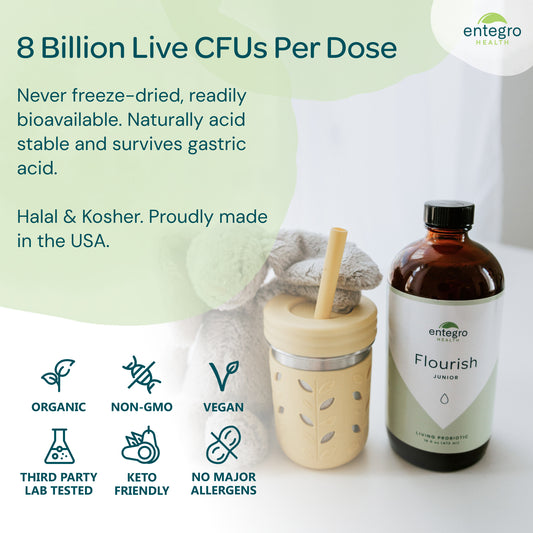
The same bottle works for everyone in the house, which is a genuinely nice thing about it. Flourish Junior is the sweeter of the two, if that helps.
The dosing chart above covers children by age, including under-ones. Follow it, and speak to your pediatrician before starting any supplement for a child.
5. It's already acidic, so it needs no help
Please don't add vinegar to it
The American Dental Association advises against drinking apple cider vinegar at all, recommending it be kept to cooking. For anyone who does drink it: dilute it, use a straw, rinse afterwards, and wait an hour before brushing.2 A published case report attributed severe dental erosion to daily undiluted apple cider vinegar,3 and an undiluted shot is the harshest way to take it.
Flourish already sits at pH 2 to 3, which is inside the range your stomach operates in — gastric fluid runs about 1.5 to 3.5.4 There's nothing for the vinegar to add.
And four honest trade-offs

A liquid isn't better at everything. Four places a capsule wins:
Shipping
Glass and liquid are heavy, and heavy is expensive. We've worked out how to get it to you intact, but it will never be as cheap to post as a bottle of capsules.
Measuring
The flip side of flexible dosing is that you have to measure. A capsule is one swallow and done.
Taste
Original ferments on molasses and comes out stout; Junior on sorghum and comes out closer to apple cider. Both taste of something, which a capsule doesn't. Plenty of people mix it into juice, and plenty prefer it straight.
Portability
A capsule fits in a pocket. A bottle needs a bit more planning, and follow the storage guidance on the label once it's open.
If those matter more to you than the reasons above, a capsule is a perfectly reasonable choice. We'd rather say so than pretend otherwise.
Where does Flourish fit?
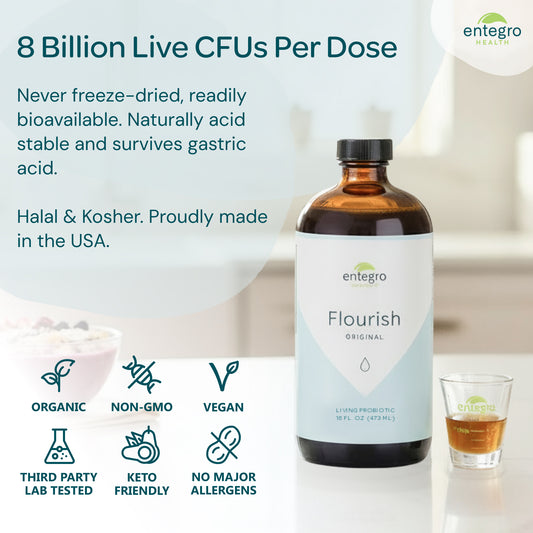
Flourish Original and Flourish Junior are living liquid probiotics — eleven strains from five families, small-batch fermented in Iowa — taken daily to support digestive and microbiome health.
Flourish is a dietary supplement made to support digestive and microbiome health. It isn't a treatment for any condition. Follow the dosage on the label. Check with your doctor before starting a new supplement, and with your pediatrician before giving one to a child.

Ready to try a living probiotic?
Eleven living strains. One daily shot. For the whole family.
Shop Flourish Original · Shop Flourish Junior · When to take it
A few questions we hear a lot
Is liquid better than a capsule?
Better at some things. The bacteria are alive and already acid-adapted rather than freeze-dried, and you can measure any amount. A capsule is lighter, cheaper to ship, tasteless and more portable. Both are legitimate.
Can I put it in a hot drink?
No. It's a living liquid and heat undoes it. Cold drinks only, and add it to the portion you're about to drink.
Should I mix it with apple cider vinegar?
Flourish is already acidic at around pH 2 to 3, so vinegar adds nothing — and the ADA advises against drinking vinegar because of enamel erosion.2,3
Can I take more than the label says?
Ask your doctor. A liquid makes it easy to measure a different amount, which is not the same as a reason to. The label is the guidance we stand behind.
Can children take it?
Follow the dosage on the bottle and check with your pediatrician first. The practical advantage is real — no splitting tablets — but the dosing question is theirs to answer, not ours.
Why do the strains being fermented together matter?
Because metabolites produced by one organism become resources for another, and the acidic environment they build is what keeps the community stable in the bottle.1
About this article
Written by: Lorilyn Van Dyke and Lynn Haak, Entegro Health | Originally published: December 2021
Important information
This article is for general education and isn't a substitute for professional medical advice, diagnosis, or treatment. Follow the dosage printed on the product label; do not exceed it without speaking to a qualified health provider. Persistent digestive symptoms should be assessed by a doctor rather than self-managed. These statements have not been evaluated by the Food and Drug Administration. This product is not intended to diagnose, treat, cure, or prevent any disease.
Sources
- Sieuwerts, S., Molenaar, D., van Hijum, S. A. F. T., et al. (2010). Mixed-culture transcriptome analysis reveals the molecular basis of mixed-culture growth in Streptococcus thermophilus and Lactobacillus bulgaricus. Applied and Environmental Microbiology, 76(23), 7775–7784. Source
- American Dental Association. Experts provide latest science on apple cider vinegar — recommendation to avoid drinking it, and precautions for those who do. Source
- Gambon, D. L., Brand, H. S., & Veerman, E. C. I. (2012). Unhealthy weight loss: erosion by apple cider vinegar. Nederlands Tijdschrift voor Tandheelkunde, 119(12), 589–591 — a case of severe dental erosion attributed to daily undiluted apple cider vinegar. Source
- Stomach acid test — normal gastric fluid pH 1.5 to 3.5. A.D.A.M. medical encyclopedia content, UF Health. Source