Summer Is Medicine
Your gut keeps a summer and a winter. That is not a figure of speech — it has been measured, in two populations that could hardly be less alike. And summer happens to hand you, cheaply, the things that actually move the needle.
Photo: Daniel Flores/ https://www.pexels.com
The gut has seasons, and two studies caught them
Sixty Hutterites — a communal farming community in the northern United States — were sampled in winter and again in summer. The researchers found consistent, significant, population-wide shifts in microbiome composition across the seasons1. Same people, same community, same kitchens — and a gut that looked measurably different in July than it did in January.
The Hadza of Tanzania gave the dramatic version. Sampled across a full year, some bacterial groups became undetectable in the dry season and reappeared in the wet one2 — a whole community cycling in and out of view with the food supply.
How to read these two
Both are observational — nobody assigns anyone a season. The Hadza are hunter-gatherers whose diet swings further across a year than almost any modern one, and the Hutterites eat largely from what they grow. Neither population is a stand-in for a household with a supermarket down the road, and neither study tested a supplement.
It is the plate doing the work
If the season moves the gut, it moves it through food — and faster than you would guess. Ten volunteers switched to an entirely animal-based or entirely plant-based diet, and their gut communities shifted within a single day of the new food arriving3. Ten people, five days. Small study, but the speed is the headline.
The broader pattern lines up. In the American Gut dataset, people eating more than thirty types of plant in a week carried more diverse gut communities than those eating ten or fewer4.
Which is where summer earns the title. From June to September, the thirty-plant week stops being a project and turns into ordinary shopping. Stone fruit, berries, tomatoes, corn, beans, squash, herbs, salad leaves, the good version of everything. For a few months a year the useful advice and the easy advice are the same advice.
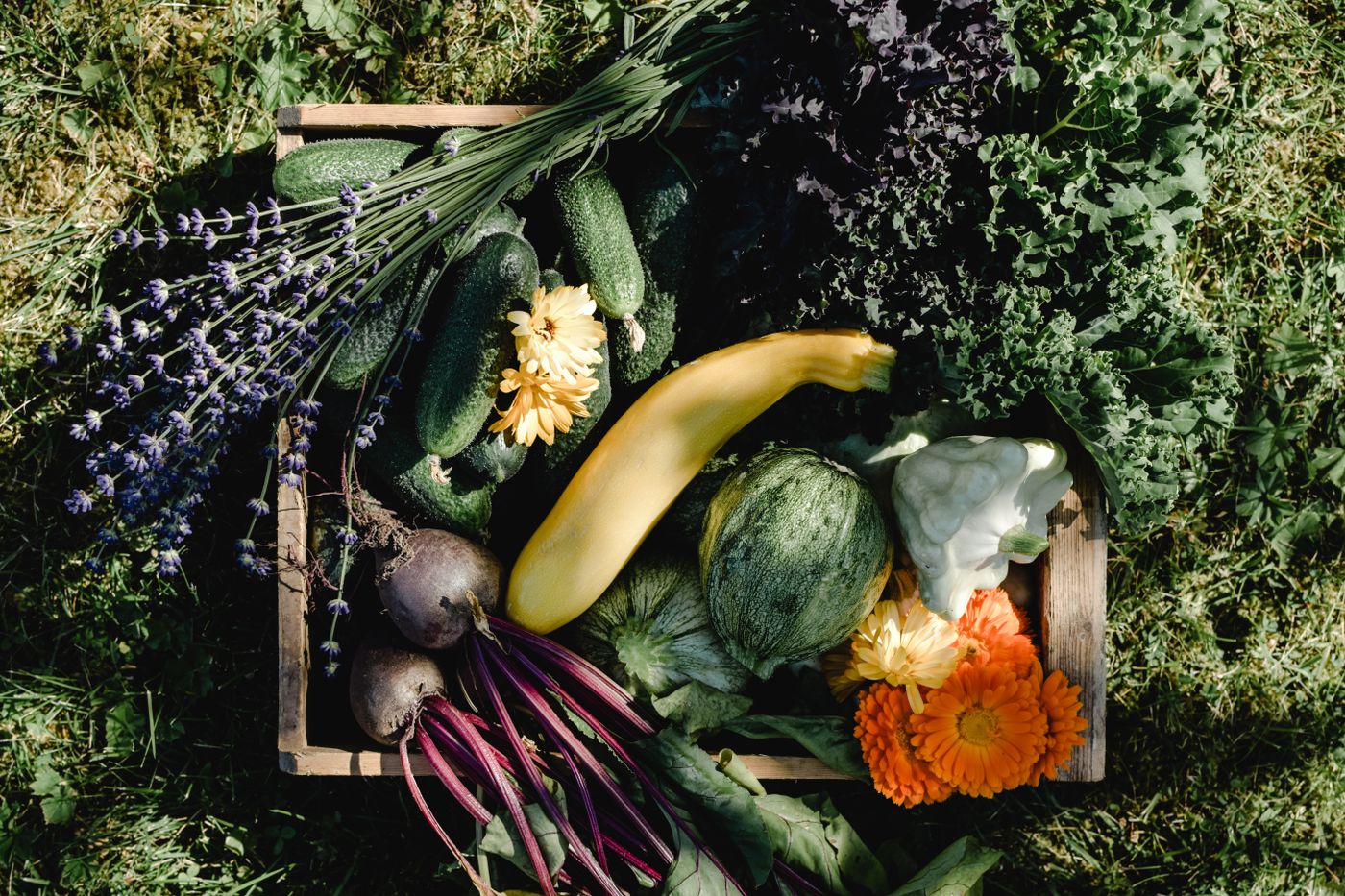
Photo: Eva Bronzini/ https://www.pexels.com
For one season a year, eating well stops being a discipline and starts being a menu.
Long days, late dinners
The gut community is not a still photograph. It rises and falls on a daily cycle, and disrupting the cycle disturbs it5. That finding rests mainly on mouse work; the human side was two volunteers flown across eight time zones, which makes it an observation rather than a trial.
Summer is the season that quietly wrecks meal timing — light until ten, dinner at nine, a different schedule every weekend. Eating at roughly consistent hours is the free correction, and it costs nothing but attention.
Heat, water and keeping things moving
In 53 women, stool consistency was strongly associated with gut microbiota richness and composition6. How fast things move through you and what lives inside you travel together.
That study measured consistency rather than water intake, so it is not proof that a bigger water bottle rearranges your microbiome. It is simply a good reason to take the ordinary summer advice — drink to thirst in the heat, keep the fiber up, keep moving — more seriously than you might otherwise.

A short summer list
- Shop the season. Count plant types across a week rather than servings in a day.
- Hold meal times roughly steady, even when the light says otherwise.
- Drink to thirst in the heat. Old advice, and it was good before anyone sequenced anything.
- Eat the odd ones. Herbs, seeds, beans and spices all count toward the thirty.
None of the research on this page was carried out on Flourish. It is a food supplement, and it belongs next to that list rather than at the top of it.
About this article
Written by: Lynn Haak, Entegro Health | Originally published: June 2026
Important information
This article is for general education and isn’t a substitute for professional medical advice, diagnosis, or treatment. Nothing here diagnoses, treats, cures or prevents any condition. If you have ongoing digestive symptoms, or any other health concern, please speak to a qualified health professional rather than reaching for a supplement.
These statements have not been evaluated by the Food and Drug Administration. This product is not intended to diagnose, treat, cure, or prevent any disease.
Sources
- Davenport, E. R., Mizrahi-Man, O., Michelini, K., Barreiro, L. B., Ober, C., & Gilad, Y. (2014). Seasonal variation in human gut microbiome composition. PLoS ONE, 9(3), e90731 — 60 Hutterites sampled in winter and again in summer; “consistent and significant population-wide shifts in microbiome composition across seasons.” Source
- Smits, S. A., Leach, J., Sonnenburg, E. D., Gonzalez, C. G., Lichtman, J. S., Reid, G., Knight, R., et al. (2017). Seasonal cycling in the gut microbiome of the Hadza hunter-gatherers of Tanzania. Science, 357(6353), 802–806 — a year of sampling; some taxa became undetectable in the dry season and reappeared in the wet season. Source
- David, L. A., Maurice, C. F., Carmody, R. N., Gootenberg, D. B., Button, J. E., Wolfe, B. E., Ling, A. V., Devlin, A. S., et al. (2014). Diet rapidly and reproducibly alters the human gut microbiome. Nature, 505(7484), 559–563 — 10 volunteers spent five days on an entirely animal-based or entirely plant-based diet; the gut community shifted within a single day of the new food arriving. Source
- McDonald, D., Hyde, E., Debelius, J. W., Morton, J. T., Gonzalez, A., Ackermann, G., Aksenov, A. A., Behsaz, B., et al. (2018). American Gut: an open platform for citizen science microbiome research. mSystems, 3(3), e00031-18 — self-reported data from thousands of participants; people eating more than 30 types of plant per week carried more diverse gut communities than those eating 10 or fewer. Source
- Thaiss, C. A., Zeevi, D., Levy, M., Zilberman-Schapira, G., Suez, J., Tengeler, A. C., Abramson, L., Katz, M. N., et al. (2014). Transkingdom control of microbiota diurnal oscillations promotes metabolic homeostasis. Cell, 159(3), 514–529 — the gut community rises and falls on a daily cycle; disrupting that cycle in mice disturbed it, and transferring the disturbed community into germ-free mice produced obesity and glucose intolerance. The human arm was two volunteers flown across eight time zones. Source
- Vandeputte, D., Falony, G., Vieira-Silva, S., Tito, R. Y., Joossens, M., & Raes, J. (2016). Stool consistency is strongly associated with gut microbiota richness and composition, enterotypes and bacterial growth rates. Gut, 65(1), 57–62 — 53 women; how fast things move through you tracks with what lives in you. Source