Spring Cleaning Your Gut
Every spring, the windows go up, the closets get emptied, and somebody in the house suggests a fresh start. It turns out the instinct has a decent amount of biology behind it — just not the biology the wellness aisle usually sells you.

Photo: Elena Golovchenko/ https://www.pexels.com
At Entegro Health we make a living liquid probiotic, so treat what follows with the suspicion you would apply to anyone selling you something. It also means we went and read the actual papers. Some of what we found makes the spring conceit better than we expected. Some of it meant cutting sentences we had written in earlier versions of this article.
Your gut really does have seasons
This is the part that genuinely surprised us. In 2014, researchers followed 60 members of a Hutterite community in the northern United States across a full year, sampling in winter and again in summer1. The Hutterites were a near-perfect natural experiment: they live communally and eat almost identically to one another, and their diet is, in the authors’ words, “remarkably stable throughout the year, with the exception that fresh produce is primarily served during the summer and autumn months.”
One variable. Fresh produce. And the result was that “despite overall gut microbiome stability within individuals over time, there are consistent and significant population-wide shifts in microbiome composition across seasons”1 — changes in the abundance of major bacterial groups, and a measurable change in overall diversity.

Photo: Maria Verkhoturtseva/ https://www.pexels.com
The authors’ own explanation is the plain one: “It is likely that the dietary fluctuations between seasons with respect to produce availability explain, at least in part, these differences in microbiome composition”1.
The gut follows the plate.
The effect is not unique to one community, either. A separate team tracked 350 stool samples over more than a year among the Hadza of Tanzania and found “annual cyclic reconfiguration of the microbiome, in which some taxa become undetectable only to reappear in a subsequent season”2. Different continent, different diet, same phenomenon: the community inside you moves with the year.
What these studies do and don’t show
Both are observational. Nobody randomly assigned anyone to a spring diet and measured what happened. What they establish is that seasonal shifts are real and that diet is the likeliest driver — not that changing your diet in April produces any particular outcome. We could find no seasonal-diet intervention trial at all. So read this as a good reason to pay attention in spring, not as a promise about what spring will do for you.
Step 1: Reset the routine, not the whole life
Just as you would with a house, start with the things you will actually keep doing.
Eat with the season
This is the one the Hutterite study points straight at. Spring is when the fresh, fiber-rich things come back — leafy greens, radishes, asparagus, the first berries. Fiber matters here because a good deal of it is not digested by you at all; it reaches the large intestine and becomes food for the microbes living there3.
A small precision note, because we would rather be accurate than tidy: not all fiber is a prebiotic. The formal definition is narrower — “a substrate that is selectively utilized by host microorganisms conferring a health benefit”4, with the word selectively doing real work. Plenty of fiber is useful without meeting that bar. Eat the vegetables anyway.

Photo: Christianna Otto/ https://www.pexels.com
Let your meals keep time
Here is something we have said badly in the past. Earlier versions of this article told you that taking your probiotic at the same time each day “helps establish stability in your digestive system.” We went looking for the study behind that sentence and there isn’t one. Not a weak one — none. No trial of any design has tested whether consistency of dosing time changes any probiotic outcome.
What is established is more interesting anyway. Your gut keeps time. The microbial community in the intestine “exhibits diurnal oscillations that are influenced by feeding rhythms, leading to time-specific compositional and functional profiles over the course of a day” — in mice and in humans5. The clock that community runs on is set by when you eat, not by when you take a supplement.
So the practical version is: regular meals. And if you want a daily habit to stick, hang it on one of them. Taking Flourish with breakfast works not because breakfast is metabolically magical but because breakfast happens every day and you will remember.
Move, gently
This one has better evidence than we expected, and it is old. In 1991, ten healthy volunteers were put through a crossover study of an hour a day of moderate exercise — jogging or cycling, nothing heroic. Whole-gut transit time fell from 51.2 hours at rest to 36.6 hours while cycling and 34.0 hours while jogging6. Stool weight, how often people went, fiber intake and fluid intake all stayed the same. The only thing that changed was the speed.
Roughly a day and a half down to a day and a half less a bit, from an hour of ordinary movement. Gardening counts. So does the walk you keep meaning to take.

Photo: Helena Lopes/ https://www.pexels.com
Simplify
Clutter overwhelms a house, and an overcomplicated wellness routine overwhelms a person. Three habits you keep for a year beat eleven you keep for two weeks. This is not a scientific finding; it is just true.

Photo: PNW Production/ https://www.pexels.com
Step 2: Restore balance — don’t “detox”
Your body already has a detoxification system, and it is not for sale. It runs continuously, primarily through the liver and kidneys, with the gut, lungs and skin all playing a part. It does not need to be activated, unlocked, or supported by anything you buy in April.
If that sounds like an unusually blunt thing for a supplement company to write, here is the evidence. A 2015 critical review in the Journal of Human Nutrition and Dietetics went looking for clinical support for commercial detox products and reported: “To the best of our knowledge, no randomised controlled trials have been conducted to assess the effectiveness of commercial detox diets in humans”7. The authors also noted that “although the detox industry is booming, there is very little clinical evidence to support the use of these diets.”
The sentence we are not going to write
“Supports your body’s natural detox pathways.” That is the industry’s standard hedge, it appears on thousands of labels, and it means nothing. It implies action on a process the reader understands as toxin removal, with no evidence behind it. Flourish does not detoxify anything. We would rather say so plainly than dress it up in a softer verb.

Photo: cottonbro studio/ https://www.pexels.com
So what is a well-fed gut community actually good for?
A shorter list than you will read elsewhere, and every item on it is one we can stand behind:
- It supports the immune system — the wording is deliberate. It is the phrasing FDA itself gives as an acceptable example, and we are using it exactly as written rather than embellishing it into something about defenses or resistance.
- It helps promote digestion — again, FDA’s own worked example of an acceptable structure/function statement.
- It helps maintain the intestinal flora — which is a description of what a probiotic is for, not a promise about how you will feel.
And here is what we removed
Earlier drafts of this article said a healthy gut helps “regulate inflammation,” “strengthen immune defenses,” “improve nutrient absorption” and “promote clearer skin.” All four are gone. Two of them describe things a drug does, one uses a verb that implies you have a deficiency to fix, and the fourth rests on a literature that flatly contradicts itself — one 2025 meta-analysis found oral probiotics helped acne at twelve weeks, and a 2026 GRADE meta-analysis of five trials found no significant benefit on any lesion count at all8,9. Every trial in both used specific named strains, which is a further reason none of it transfers to us.
We also dropped the line about what happens “when your microbes are out of balance.” Balance is a serviceable metaphor for what a probiotic is for. It is not a diagnosis we can hand you through a screen — and the field itself is having second thoughts about the underlying concept. A 2024 review in Gut put it bluntly: there is “a problematic issue with the term ‘dysbiosis’, which broadly links microbial imbalances to various chronic illnesses without precision or definition”10.
For what it is worth, the trillions are real. The best current estimate puts the bacterial population of a 70 kg adult at about 38 trillion cells — roughly the same order as the number of your own cells, not the ten-to-one ratio you may have heard11.
Step 3: Commit to the boring part
Spring cleaning is not a one-time event; it sets a tone for the months after. The same is true of anything you do for your gut. Consistency is the whole mechanism, and it is not glamorous.

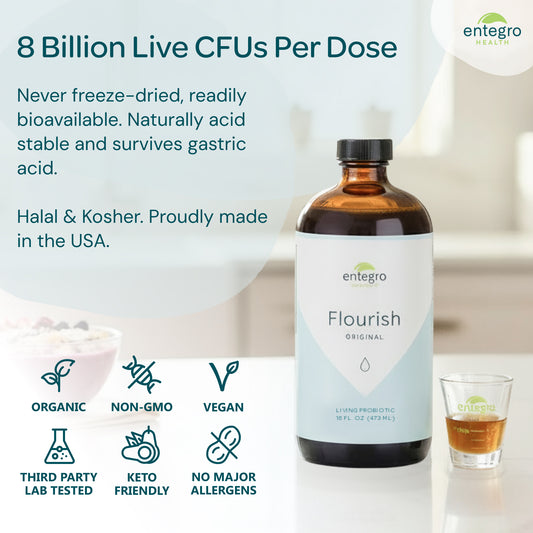
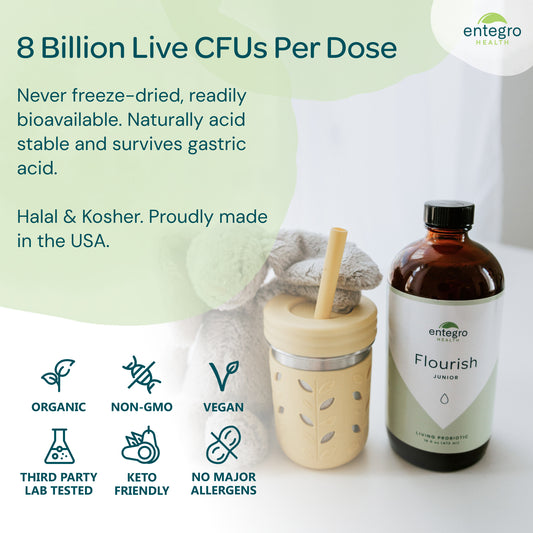
Flourish is a fermented living liquid. The organisms are in suspension — they are never dried. It pours; you can measure a dose or stir it into water or juice; there is no capsule to swallow. Those are facts about how our product is made and used, and they are the kind of thing we can actually verify.
A comparison we used to make, and won’t any more
This article previously said that “unlike powdered probiotic supplements that may contain dormant strains, a living liquid probiotic introduces active beneficial bacteria.” We went looking for the head-to-head evidence and there is none — not one registered or published trial comparing liquid with freeze-dried probiotics on any clinical endpoint.
Worse, “dormant” was the wrong word. Freeze-dried bacteria are not dormant in the way spores are dormant; they are desiccated, and they revive on rehydration. Drying is in fact the field’s standard answer to the shelf-life problem — one review describes shelf-life viability as “optimally achieved by drying them before further formulation”12. Keeping organisms alive in a liquid is the harder engineering problem, not the easier one, and we were quietly claiming credit for solving it better without any data. The international consensus definition of a probiotic — “live microorganisms which when administered in adequate amounts confer a health benefit on the host”13 — says nothing about format at all.
One more piece of honesty while we are here. We used to say Flourish helps “replenish” your beneficial bacteria. Replenish implies restocking a depleted store, and the evidence points the other way: colonization after a probiotic is transient and highly individual, with “person-, region- and strain-specific mucosal colonization patterns”14. So the accurate version is simpler. Flourish adds live cultures to your day. Whether they take up residence is a different question, and the answer appears to be personal to you.
We have also cut “and even mood” from the closing paragraph. The probiotics-and-mood literature finds effects in people with a diagnosis and, in healthy adults, an effect indistinguishable from zero15,16. It was a nice sentence. It was not a true one.
A fresh start from the inside out
So: open the windows. Put the greens back on the plate, because that appears to be what actually moves the needle across a season. Eat at roughly the same times. Walk. Keep the routine short enough that you will still be doing it in July.
Spring is a reminder that growth happens when the conditions are right, and very little of it happens because somebody sold you a reset. Here’s to lighter days, fresh beginnings, and a shorter list of things to keep up with.
About this article
Written by: Lynn Haak, Entegro Health | Originally published: March 2026
Important information
This article is for general education and isn’t a substitute for professional medical advice, diagnosis, or treatment. Nothing here diagnoses, treats, cures or prevents any condition. If you have ongoing digestive symptoms, unexplained fatigue, or any other health concern, please speak to a qualified health professional rather than reaching for a supplement.
These statements have not been evaluated by the Food and Drug Administration. This product is not intended to diagnose, treat, cure, or prevent any disease.
Sources
- Davenport, E. R., Mizrahi-Man, O., Michelini, K., Barreiro, L. B., Ober, C., & Gilad, Y. (2014). Seasonal variation in human gut microbiome composition. PLoS ONE, 9(3), e90731 — 60 Hutterites sampled winter and summer; “consistent and significant population-wide shifts in microbiome composition across seasons.” Source
- Smits, S. A., Leach, J., Sonnenburg, E. D., Gonzalez, C. G., Lichtman, J. S., Reid, G., et al. (2017). Seasonal cycling in the gut microbiome of the Hadza hunter-gatherers of Tanzania. Science, 357(6353), 802–806 — 350 samples over more than a year; “annual cyclic reconfiguration of the microbiome.” Source
- Makki, K., Deehan, E. C., Walter, J., & Bäckhed, F. (2018). The impact of dietary fiber on gut microbiota in host health and disease. Cell Host & Microbe, 23(6), 705–715. Source
- Gibson, G. R., Hutkins, R., Sanders, M. E., Prescott, S. L., Reimer, R. A., Salminen, S. J., et al. (2017). Expert consensus document: The International Scientific Association for Probiotics and Prebiotics (ISAPP) consensus statement on the definition and scope of prebiotics. Nature Reviews Gastroenterology & Hepatology, 14(8), 491–502 — “a substrate that is selectively utilized by host microorganisms conferring a health benefit.” Source
- Thaiss, C. A., Zeevi, D., Levy, M., Zilberman-Schapira, G., Suez, J., Tengeler, A. C., et al. (2014). Transkingdom control of microbiota diurnal oscillations promotes metabolic homeostasis. Cell, 159(3), 514–529 — “diurnal oscillations that are influenced by feeding rhythms,” in mice and humans. Source
- Oettlé, G. J. (1991). Effect of moderate exercise on bowel habit. Gut, 32(8), 941–944 — whole-gut transit 51.2 hours at rest, 36.6 hours cycling, 34.0 hours jogging; ten healthy volunteers, crossover design. Source
- Klein, A. V., & Kiat, H. (2015). Detox diets for toxin elimination and weight management: a critical review of the evidence. Journal of Human Nutrition and Dietetics, 28(6), 675–686 — “no randomised controlled trials have been conducted to assess the effectiveness of commercial detox diets in humans.” Source
- Lin, H. W., Tam, K. W., & Huang, Y. C. (2025). Efficacy of oral probiotics in patients with acne: a systematic review and meta-analysis of randomized trials. Clinical and Experimental Dermatology, 51(1), 68–77 — benefit at 12 weeks; “probiotics may exert therapeutic effects.” Source
- Abedin, Z. U., et al. (2026). Lactobacillus-based microbiome therapy for acne vulgaris: a GRADE systematic review and meta-analysis of randomized controlled trials. Journal of Cosmetic Dermatology, 25(3), e70792 — five RCTs, 332 participants; “do not provide significant clinical benefits.” Source
- Van Hul, M., Cani, P. D., Petitfils, C., De Vos, W. M., Tilg, H., & El-Omar, E. M. (2024). What defines a healthy gut microbiome? Gut, 73(11), 1893–1908 — “a problematic issue with the term ‘dysbiosis’, which broadly links microbial imbalances to various chronic illnesses without precision or definition.” Source
- Sender, R., Fuchs, S., & Milo, R. (2016). Revised estimates for the number of human and bacteria cells in the body. PLoS Biology, 14(8), e1002533 — 3.8 × 10¹³ bacteria; “the same order as the number of human cells.” Source
- Broeckx, G., Vandenheuvel, D., Claes, I. J., Lebeer, S., & Kiekens, F. (2016). Drying techniques of probiotic bacteria as an important step towards the development of novel pharmabiotics. International Journal of Pharmaceutics, 505(1–2), 303–318 — shelf-life effects “optimally achieved by drying them before further formulation”; rehydration conditions affect revival. Source
- Hill, C., Guarner, F., Reid, G., Gibson, G. R., Merenstein, D. J., Pot, B., et al. (2014). Expert consensus document: The International Scientific Association for Probiotics and Prebiotics consensus statement on the scope and appropriate use of the term probiotic. Nature Reviews Gastroenterology & Hepatology, 11(8), 506–514 — “live microorganisms which when administered in adequate amounts confer a health benefit on the host.” Source
- Zmora, N., Zilberman-Schapira, G., Suez, J., Mor, U., Dori-Bachash, M., Bashiardes, S., et al. (2018). Personalized gut mucosal colonization resistance to empiric probiotics is associated with unique host and microbiome features. Cell, 174(6), 1388–1405.e21 — “person-, region- and strain-specific mucosal colonization patterns.” Source
- Chao, L., Liu, C., Sutthawongwadee, S., Li, Y., Lv, W., Chen, W., et al. (2020). Effects of probiotics on depressive or anxiety variables in healthy participants under stress conditions or with a depressive or anxiety diagnosis: a meta-analysis of randomized controlled trials. Frontiers in Neurology, 11, 421 — effect only in diagnosed depression; “no improvement in participant performance under stress.” Source
- Breuling, M., et al. (2024). Butyrate- and beta-hydroxybutyrate-mediated effects of interventions with pro- and prebiotics, fasting, and caloric restrictions on depression: a systematic review and meta-analysis. Life, 14(7), 787 — depression SMD 0.15 (95% CI −0.35 to 0.70) in healthy adults, i.e. no significant effect. Source