Probiotics and the Immune System
Your gut and your immune system are genuinely entangled. What that does and doesn't mean for a daily probiotic is a more interesting question than the internet lets on — starting with a statistic almost everyone gets wrong.

The line everyone repeats — and what's actually true
"About 70 to 80% of your immune system is in your gut." You have read it on every supplement website in existence.
In 2023 a team finally did the counting properly — a full census of the immune cells in the human body, combining literature, imaging and methylome analysis. Their finding: the gastrointestinal tract holds about 3% of the body's immune cells and around 5% of its lymphocytes. Most immune cells live in bone marrow, lymph nodes and the spleen.1
So where did 70% come from? A 2008 review described gut-associated lymphoid tissue as representing "almost 70% of the entire immune system" and noted that about 80% of plasma cells reside there.2 Two numbers, one of them well founded, and the supplement industry has been blending them for fifteen years.
The accurate version, which is better anyway
The gut is home to roughly 70% of the body's antibody-producing plasma cells — making it the largest single compartment of the humoral immune system.1 Not most of your immune system. Most of your antibody factory. That's a sharper and more useful fact than the one it replaces, and it doesn't fall over when someone checks it.
We go through the architecture — the mucus layers, the tight junctions, Peyer's patches — in Immune System + Microbiome. This article is about the narrower question: what happens when you take a probiotic.
What your gut microbes actually do
Two things, mainly, and neither is what the marketing says.
They take up the room. A resident community occupies the space and eats the food a pathogen would need — competing for nutrients, producing bacteriocins, altering bile acids, and prompting your own cells to make antimicrobial peptides. This is called colonisation resistance and it's established microbial ecology rather than a wellness talking point.3,4
They talk to your immune cells. Short-chain fatty acids made by fermenting fibre act on receptors in the gut and beyond; the documented immunological effects run mostly toward regulatory T cells, anti-inflammatory signals like IL-10 and TGF-β, secretory IgA, and maintenance of the barrier itself.5,6 Some of that signalling reaches the lungs, which is the reason respiratory outcomes come up at all in this literature.21
Which is a thermostat, not a switch.
That's worth sitting with, because "turns on your immune system to fight off bad bugs" is how it usually gets described, and it has the biology backwards. Most of what gut bacteria do immunologically is regulatory — calming, gating, tolerating, keeping the response proportionate. An immune system that's permanently switched on isn't a healthy one; it's an autoimmune problem.
Worth being straight about the evidence base too: most of these mechanisms are worked out in cell culture and animal models. The reviews that describe them say so themselves, and note the effects are strain-specific rather than general to "probiotics."5,7
What knocks it about
Photo: cottonbro studio / https://www.pexels.com
Antibiotics do it fastest. When twelve healthy men were given a deliberately brutal four-day course of three broad-spectrum antibiotics, their gut communities were flattened — and then recovered to near baseline within about six weeks, though nine common species were still missing in most of them at six months.8 Real disruption, mostly reversible in healthy adults, with a tail.
Some food additives do it too, though the evidence is narrower than the headlines suggest. A controlled feeding study of the emulsifier carboxymethylcellulose found reduced microbial diversity and reduced short-chain fatty acids — in sixteen people over eleven days. A genuine human signal, and a very small one. There's no equivalent trial for "ultra-processed food" as a category.9
Heavy alcohol use shifts the community as well — biopsies from people with alcoholism showed dysbiosis correlating with markers of a leakier gut, and it persisted into sobriety. Note the population: this is chronic alcoholism, not a glass of wine on a Friday.10
All of that is well documented. The leap from "the microbiome changes" to "you become vulnerable to various diseases" is a much longer one, and the honest position is that it's an active research question rather than a settled fact.11
So does taking a probiotic actually do anything?

Photo: Ron Lach / https://www.pexels.com
The most relevant body of evidence concerns upper respiratory infections, and there is a Cochrane review of it — 23 randomised trials and around 6,950 people, from infants to the very elderly.12 Here's what it found, with the certainty ratings the reviewers themselves assigned, because those are the part that usually goes missing:
- Fewer people had at least one infection — RR 0.76 (95% CI 0.67 to 0.87). Low certainty.
- Fewer had three or more — RR 0.59 (0.38 to 0.91). Moderate certainty, but only four trials and 763 people.
- Episodes were shorter by 1.22 days (0.33 to 2.12). Low certainty.
- Fewer courses of prescribed antibiotics — RR 0.58 (0.42 to 0.81). Moderate certainty.
- No difference in side effects. Low certainty.
The reviewers' own conclusion was that probiotics were better than placebo or no treatment. That's a real result and we're not going to undersell it. But four of those five outcomes are rated low certainty, the reviewers flagged unblinded participants and incomplete reporting, and the shorter-episode figure has a lower bound of about eight hours.
Three things that keep us honest about that
It's about specific strains. The trials mostly used named organisms — Lactobacillus plantarum HEAL9, L. paracasei 8700:2, L. acidophilus NCFM — at particular doses for particular lengths of time.13,14 Probiotic effects don't transfer between products any more than the effects of one medication transfer to another.
Most of those trials were run by manufacturers. Not disqualifying, and there's no evidence funding flipped the results — but you should know it.
And the most rigorous test was negative. When researchers deliberately infected 334 volunteers with a cold virus and gave half of them a probiotic, illness rates came out at 56% versus 50% — no significant difference.15 A companion study found the same strain measurably changed an inflammatory marker and viral shedding while making no difference to whether people felt ill.16 That gap — a measurable immunological effect with no clinical payoff — is the fairest one-line summary of this whole field.
All of which is a finding about those strains in those trials. It isn't a claim about Flourish, and we aren't making one.
One thing probiotics don't do, whatever else they manage: rebuild your gut community. In healthy adults, supplementation doesn't measurably change the composition of the resident microbiota.17 Colonisation is highly individual, and what shows up in a stool sample doesn't reliably reflect what reached the gut lining.18 One study even found probiotics slowed the gut's return to baseline after antibiotics compared with simply waiting.19 The work happens in transit, which is the argument for taking one steadily rather than in bursts.
Where Flourish fits

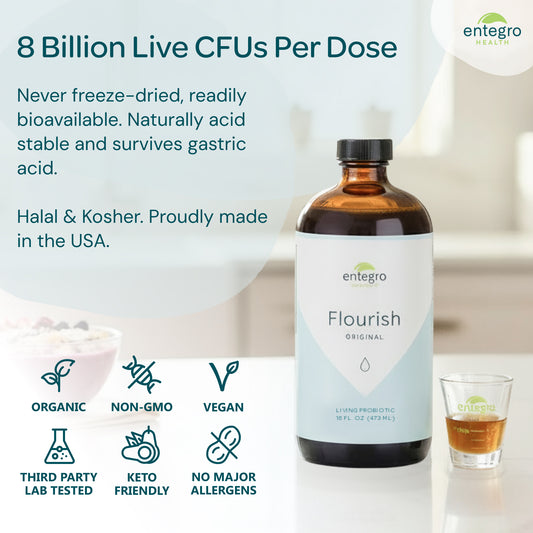
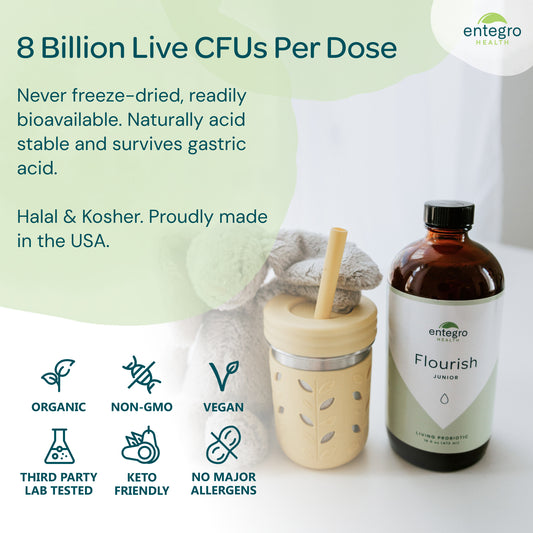
A probiotic is defined as live microorganisms that, in adequate amounts, confer a health benefit on the host.20 Flourish Original and Flourish Junior are living liquid probiotics — eleven strains across five families, grown together as one culture and delivered in the liquid they were fermented in rather than freeze-dried into a capsule.
Because nothing is dried and reconstituted, the bottle also carries what the culture produced while it grew — short-chain fatty acids among them, which is the same class of molecule doing the immunological work described further up. We'd stop short of promising you a delivery rate; nobody honestly has that number for their product.
What we claim is support for digestive and microbiome health, taken consistently. That's it — and a company that draws the line clearly is worth marginally more trust on the things it does say.
Flourish is a dietary supplement made to support digestive and microbiome health. It is not a treatment for any condition and will not prevent illness. Follow the dosage on the label. Check with your doctor before starting a new supplement — particularly if you are immunocompromised, seriously ill or pregnant — and with your pediatrician before giving one to a child.

Ready to try a living probiotic?
Eleven living strains. One daily shot. For digestive and microbiome support.
Shop Flourish Original · Shop Flourish Junior · When to take it
A few questions we hear a lot
Is most of my immune system really in my gut?
No — that's the version everyone repeats, and a 2023 census puts the gastrointestinal tract at about 3% of the body's immune cells.1 What is true is that roughly 70% of your antibody-producing plasma cells live there, which makes the gut the largest single compartment of the antibody side of your immune system.
Will a probiotic stop me getting sick?
We can't tell you that, and we wouldn't. The Cochrane evidence on respiratory infections is favourable in direction but mostly low certainty, applies to specific studied strains, and didn't hold up when researchers infected volunteers deliberately.12,15
Does a probiotic "boost" my immune system?
"Boost" is the wrong word for what's actually documented. The immunological effects that show up in the research are largely regulatory — regulatory T cells, anti-inflammatory signalling, barrier maintenance.5 Steadying rather than revving.
Will taking one rebuild my microbiome after antibiotics?
There's no good evidence for that, and one well-conducted study found probiotics actually slowed the return to baseline compared with waiting.19 In healthy adults, most of the gut community recovers on its own within about six weeks.8
Do the strains matter, or is a probiotic a probiotic?
They matter enormously. Effects are strain-specific and dose-specific, and evidence for one product does not transfer to another.5,7 Any article treating "probiotics" as one interchangeable thing is skipping the most important variable.
Is there anyone who shouldn't take one?
People who are immunocompromised or seriously ill should check with a doctor first, and so should anyone considering one for an infant. For most healthy adults they're well tolerated — the Cochrane review found no difference in adverse events versus placebo.12
About this article
Written by: Kelsy Armstrong, Entegro Health | Originally published: November 2022
Important information
This article is for general education and is not a substitute for professional medical advice, diagnosis, or treatment. Probiotic effects are specific to the strain, the dose and the outcome studied; evidence for one product does not transfer to another. Never delay seeking care, or stop a prescribed treatment, on the basis of anything you read here. These statements have not been evaluated by the Food and Drug Administration. This product is not intended to diagnose, treat, cure, or prevent any disease.
Sources
- Sender, R., Weiss, Y., Navon, Y., et al. (2023). The total mass, number, and distribution of immune cells in the human body. PNAS, 120(44), e2308511120 — the GI tract holds about 3% of immune cells and 5% of lymphocytes, while housing roughly 70% of the body's plasma cells. Source
- Vighi, G., Marcucci, F., Sensi, L., Di Cara, G., & Frati, F. (2008). Allergy and the gastrointestinal system. Clinical & Experimental Immunology, 153(Suppl 1), 3–6 — the origin of the widely repeated "70% of the entire immune system" phrasing. Source
- Buffie, C. G., & Pamer, E. G. (2013). Microbiota-mediated colonization resistance against intestinal pathogens. Nature Reviews Immunology, 13(11), 790–801. Source
- Sorbara, M. T., & Pamer, E. G. (2019). Interbacterial mechanisms of colonization resistance and the strategies pathogens use to overcome them. Mucosal Immunology, 12(1), 1–9. Source
- Plaza-Diaz, J., Ruiz-Ojeda, F. J., Gil-Campos, M., & Gil, A. (2019). Mechanisms of action of probiotics. Advances in Nutrition, 10(suppl_1), S49–S66 — notes that mechanisms are "diverse, heterogeneous, and strain specific." Source
- Azad, M. A. K., Sarker, M., & Wan, D. (2018). Immunomodulatory effects of probiotics on cytokine profiles. BioMed Research International, 2018, 8063647. Source
- Sanders, M. E., Merenstein, D. J., Reid, G., Gibson, G. R., & Rastall, R. A. (2019). Probiotics and prebiotics in intestinal health and disease: from biology to the clinic. Nature Reviews Gastroenterology & Hepatology, 16(10), 605–616. Source
- Palleja, A., Mikkelsen, K. H., Forslund, S. K., et al. (2018). Recovery of gut microbiota of healthy adults following antibiotic exposure. Nature Microbiology, 3(11), 1255–1265. Source
- Chassaing, B., Compher, C., Bonhomme, B., et al. (2022). Randomized controlled-feeding study of dietary emulsifier carboxymethylcellulose reveals detrimental impacts on the gut microbiota and metabolome. Gastroenterology, 162(3), 743–756. Source
- Mutlu, E. A., Gillevet, P. M., Rangwala, H., et al. (2012). Colonic microbiome is altered in alcoholism. American Journal of Physiology — Gastrointestinal and Liver Physiology, 302(9), G966–G978. Source
- Toor, D., Wsson, M. K., Kumar, P., et al. (2019). Dysbiosis disrupts gut immune homeostasis and promotes gastric diseases. International Journal of Molecular Sciences, 20(10), 2432. Source
- Zhao, Y., Dong, B. R., & Hao, Q. (2022). Probiotics for preventing acute upper respiratory tract infections. Cochrane Database of Systematic Reviews, 2022(8), CD006895 — all effect estimates and GRADE certainty ratings quoted above. Source
- Berggren, A., Lazou Ahrén, I., Larsson, N., & Önning, G. (2011). Randomised, double-blind and placebo-controlled study using new probiotic lactobacilli for strengthening the body immune defence against viral infections. European Journal of Nutrition, 50(3), 203–210 — first author affiliated with the manufacturer, Probi AB. Source
- Leyer, G. J., Li, S., Mubasher, M. E., Reifer, C., & Ouwehand, A. C. (2009). Probiotic effects on cold and influenza-like symptom incidence and duration in children. Pediatrics, 124(2), e172–e179 — first author affiliated with the manufacturer, Danisco. Source
- Turner, R. B., Lehtoranta, L., Hibberd, A., et al. (2021). Effect of Bifidobacterium animalis spp. lactis Bl-04 on rhinovirus-induced colds: a randomized, placebo-controlled, single-center, phase II trial in healthy volunteers. EClinicalMedicine, 43, 101224 — 56% vs 50% illness, not significant. Source
- Turner, R. B., Woodfolk, J. A., Borish, L., et al. (2017). Effect of probiotic on innate inflammatory response and viral shedding in experimental rhinovirus infection — a randomised controlled trial. Beneficial Microbes, 8(2), 207–215. Source
- Kristensen, N. B., Bryrup, T., Allin, K. H., et al. (2016). Alterations in fecal microbiota composition by probiotic supplementation in healthy adults: a systematic review of randomized controlled trials. Genome Medicine, 8(1), 52. Source
- Zmora, N., Zilberman-Schapira, G., Suez, J., et al. (2018). Personalized gut mucosal colonization resistance to empiric probiotics is associated with unique host and microbiome features. Cell, 174(6), 1388–1405.e21. Source
- Suez, J., Zmora, N., Zilberman-Schapira, G., et al. (2018). Post-antibiotic gut mucosal microbiome reconstitution is impaired by probiotics and improved by autologous FMT. Cell, 174(6), 1406–1423.e16. Source
- Hill, C., Guarner, F., Reid, G., et al. (2014). Expert consensus document: the ISAPP consensus statement on the scope and appropriate use of the term probiotic. Nature Reviews Gastroenterology & Hepatology, 11(8), 506–514. Source
- Enaud, R., Prevel, R., Ciarlo, E., et al. (2020). The gut-lung axis in health and respiratory diseases: a place for inter-organ and inter-kingdom crosstalks. Frontiers in Cellular and Infection Microbiology, 10, 9 — background on gut-lung communication. Source