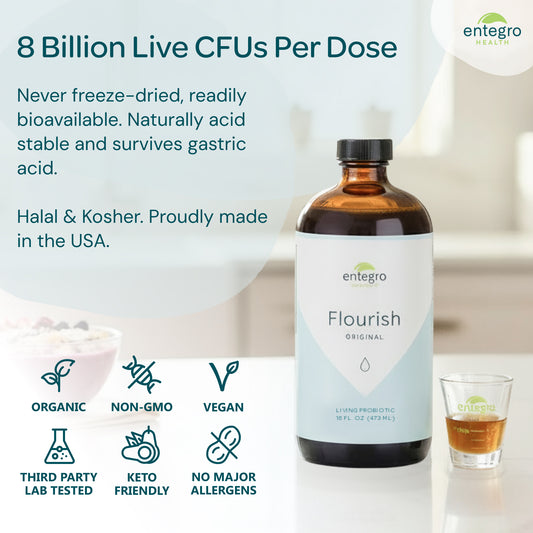
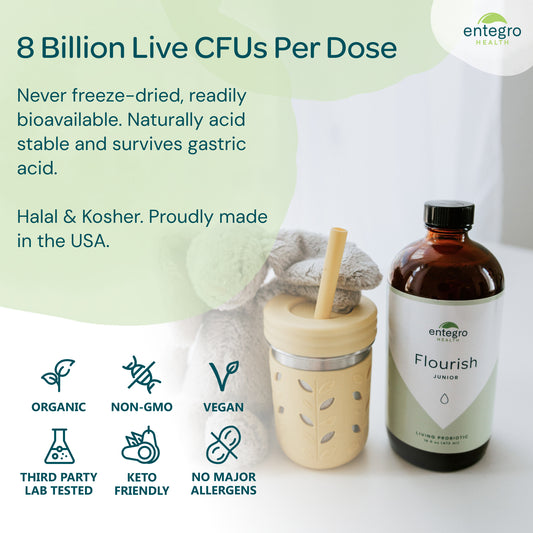
Nature's Blueprint: Why Flourish is Different
Every bottle on the shelf says it is different. Most of them mean the label. Here is what the word means for Flourish — how it is made, what is actually in it, and who makes it.

Photo: Mark Stebnicki/ https://www.pexels.com
Start with the word itself
“Probiotic” has a real definition, and it is tighter than the aisle suggests. The International Scientific Association for Probiotics and Prebiotics settled on it in 2014: live microorganisms that, when administered in adequate amounts, confer a health benefit on the host1. Three conditions, all doing work. Alive. Enough of them. And a benefit someone has actually shown.
That third one is where the category gets loose, because benefits are demonstrated for a strain — not for a genus, not for a family, and certainly not for a shelf2. Two organisms can share a species name and behave nothing alike. So when you read that “lactobacillus does X,” a step has gone missing somewhere.
We ferment it rather than press it into a pill
This is the first real difference, and it is a difference of method. Flourish is made by fermentation — the organisms are grown in a liquid medium, and the living culture goes into the bottle. ISAPP defines fermented foods as foods made through desired microbial growth and enzymatic conversions of food components3, which is a precise way of describing something people have done in crocks and barrels for a very long time.
The same statement draws a line worth repeating: fermentation describes how a thing was made, and probiotic describes what has been shown about it3. Two different claims, and they need two different kinds of evidence. Flourish is a ferment by method — that part is a fact about the process, and it is one we can show you.
Eleven organisms — ten bacteria and a yeast
Flourish carries eleven live organisms. Ten are bacteria. The eleventh, Saccharomyces cerevisiae, is a yeast. That matters the moment you start counting families, because a yeast sits outside the bacterial family tree altogether.
- All eleven organisms together: nine genera, six families.
- The ten bacteria on their own: eight genera, five families.
Why both numbers are correct
A yeast is not a bacterium, so it sits outside the bacterial family tree entirely. Count the whole bottle and you get nine genera across six families. Count only the bacteria and you get eight across five. Same product, two questions.
Photo: Anna Shvets/ https://www.pexels.com
Made in Iowa, by us
The second difference is less romantic and probably more useful: we make it ourselves, in our own facility, rather than buying someone else’s finished blend and putting our name on the front. The people who answer for what is in the bottle are the people who made it.
While we are here — supplements made in the United States are covered by the FDA’s Good Manufacturing Practice rules, which set requirements for identity, purity, strength and composition. Every compliant manufacturer meets them, so that part is table stakes. It does mean the line you read everywhere — that probiotics are simply unregulated — is wrong.
What the research on ferments actually found
The strongest recent evidence for fermented products is a randomized trial, and it is worth reading carefully. Thirty-six healthy adults spent seventeen weeks on either a high-fiber diet or a high-fermented-food diet. The fermented-food group ended with more diverse gut communities and lower markers of inflammation4.
Read the fine print with us. That trial tested foods — yogurt, kefir, kimchi, kombucha — not a supplement, and not ours. Thirty-six people is small. And diversity is a measurement researchers find useful, not something you feel on a Tuesday. It points somewhere interesting. It is not a result we get to borrow.
Know how a thing is made and you know most of what matters.
Meanwhile the best-supported thing you can do for the organisms you already have costs nothing and comes from a grocery list. In the American Gut dataset, people eating more than thirty types of plant in a week carried more diverse gut communities than people eating ten or fewer5. Self-reported and observational, so hold it loosely — but it is the clearest practical signal the field has produced.

So — different how?
- It is a live liquid ferment, not a dried powder rehydrated in a capsule.
- We make it ourselves, in our own Iowa facility, rather than relabeling a blend we bought.
- Eleven organisms across nine genera and six families, one of them a yeast.
Flourish is a food supplement. If you are managing a diagnosed condition, are pregnant or breastfeeding, or take prescription medication, talk it through with your clinician before adding anything new — this one included.
About this article
Written by: Lynn Haak, Entegro Health | Originally published: April 2026
Important information
This article is for general education and isn’t a substitute for professional medical advice, diagnosis, or treatment. Nothing here diagnoses, treats, cures or prevents any condition. If you have ongoing digestive symptoms, or any other health concern, please speak to a qualified health professional rather than reaching for a supplement.
These statements have not been evaluated by the Food and Drug Administration. This product is not intended to diagnose, treat, cure, or prevent any disease.
Sources
- Hill, C., Guarner, F., Reid, G., Gibson, G. R., Merenstein, D. J., Pot, B., Morelli, L., Berni Canani, R., et al. (2014). The International Scientific Association for Probiotics and Prebiotics consensus statement on the scope and appropriate use of the term probiotic. Nature Reviews Gastroenterology & Hepatology, 11(8), 506–514 — the definition this article uses: “live microorganisms that, when administered in adequate amounts, confer a health benefit on the host.” Source
- Sanders, M. E., Merenstein, D. J., Reid, G., Gibson, G. R., & Rastall, R. A. (2019). Probiotics and prebiotics in intestinal health and disease: from biology to the clinic. Nature Reviews Gastroenterology & Hepatology, 16(10), 605–616 — review setting out why effects are strain-specific and cannot be generalized across a category. Source
- Marco, M. L., Sanders, M. E., Gänzle, M., Arrieta, M. C., Cotter, P. D., De Vuyst, L., Hill, C., Holzapfel, W., et al. (2021). The International Scientific Association for Probiotics and Prebiotics (ISAPP) consensus statement on fermented foods. Nature Reviews Gastroenterology & Hepatology, 18(3), 196–208 — defines fermented foods as “foods made through desired microbial growth and enzymatic conversions of food components,” and separates them from probiotics. Source
- Wastyk, H. C., Fragiadakis, G. K., Perelman, D., Dahan, D., Merrill, B. D., Yu, F. B., Topf, M., Gonzalez, C. G., et al. (2021). Gut-microbiota-targeted diets modulate human immune status. Cell, 184(16), 4137–4153.e14 — 36 healthy adults randomized for 17 weeks; the fermented-food arm showed increased microbiota diversity and decreased inflammatory markers. Source
- McDonald, D., Hyde, E., Debelius, J. W., Morton, J. T., Gonzalez, A., Ackermann, G., Aksenov, A. A., Behsaz, B., et al. (2018). American Gut: an open platform for citizen science microbiome research. mSystems, 3(3), e00031-18 — self-reported data from thousands of participants; people eating more than 30 types of plant per week carried more diverse gut communities than those eating 10 or fewer. Source