Flourish & Synergy
Bacteria don't live alone. They feed each other, poison each other, swap genes and occasionally hold an entire neighborhood hostage. Here's what microbial community life actually looks like — and why we brew Flourish as one culture rather than eleven.

Photo: Francesco Ungaro / https://www.pexels.com
What synergy actually means
The dictionary is unglamorous about it. Synergy is "the extra energy, power, success, etc. that is achieved by two or more people, companies or elements working together, instead of on their own."1 The word comes from the Greek sunergos — sun, together, plus ergon, work. Working together. That's the whole etymology, and it's a better description of a fermentation vessel than of most quarterly strategy meetings.
Note the word elements. The definition was never limited to boardrooms. It applies perfectly well to organisms that have been doing this for three and a half billion years without a single slide deck.
No microbe is an island
That line comes from a 2016 review of bacterial communities, which borrows it — knowingly — from John Donne. Its point is sharp: a great many bacterial genes look "non-essential" in a laboratory flask and turn out to be critical the moment the organism has neighbors. "To truly understand a bacterial species," the authors write, "it must be placed within its ecological context including the other members of its community."2
This isn't a fringe position. The overwhelming majority of bacteria on Earth live in aggregated, surface-attached communities — biofilms — rather than drifting about as lone cells.3 On a rock, under a rotting log, in a coral reef, on your skin, in your colon: crowds, everywhere, all the time.
You can see it written into their genomes. In 2016, researchers built Mycoplasma mycoides JCVI-syn3.0, a synthetic bacterium stripped down to a minimal genome: 531 kilobase pairs, 473 genes.4 It lives a pampered life in rich laboratory media. Compare the soil bacterium Myxococcus xanthus, which has to survive actual neighbors: 9.14 megabase pairs and 7,388 protein-coding genes, an enormous share of them devoted to sensing what else is out there.2 Genome size is, among other things, a readout of how many other organisms you have to deal with.
They are not always nice about it
Here is where the usual telling of this story goes soft, and where it gets interesting instead. Bacterial communities are not a drum circle. They are mostly a fight, and the cooperation grows out of the fight.
Chemical warfare in your mouth, right now. Dental plaque hosts Streptococcus sanguinis, a commensal, alongside Streptococcus mutans, the one associated with cavities. Given oxygen, S. sanguinis oxidizes pyruvate and releases hydrogen peroxide as a byproduct, which suppresses its rival.5 A harmless resident of your mouth is bleaching your cavity bacteria as you read this.
Mutually assured destruction in the open ocean. Synechococcus mops up hydrogen peroxide with an enzyme called catalase-peroxidase, encoded by the gene katG. Its neighbor Prochlorococcus — one of the most abundant photosynthetic organisms on the planet — threw its own copy of katG away and free-rides on the enzyme next door, spending the saved energy on growth. The catch is that if Synechococcus ever loses katG too, both of them die.6 The gene survives because losing it would take out the whole neighborhood.
Cooperative community interactions may be born out of selection under competitive pressures.
That sentence is the review's own conclusion,2 and it is a more honest description of a microbial community than "harmony." Cooperation here isn't sentiment. It's what's left standing after several billion years of competition, and it's load-bearing.
And yes, they swap genes
Bacteria trade DNA sideways rather than only passing it down: picking up loose fragments from their surroundings, receiving deliveries by virus, or plugging into a neighbor and transferring a plasmid directly. Horizontal gene transfer is a large part of why bacteria adapt as fast as they do.7
It is also the main mechanism by which antibiotic resistance spreads through the world's microbial ecosystems,8 which is not a thing to celebrate uncritically in an article about beneficial bacteria. Resistance genes have been found across the lactobacilli, and a handful sit next to mobile elements capable of moving them.9 This is precisely why regulators expect probiotic strains to be characterized for transferable resistance — and why a strain's identity, documented to the strain level, matters more than the genus printed on the front of a bottle.
The mutualism everybody gets wrong

Photo: Mike van Schoonderwalt / https://www.pexels.com
Every biology textbook uses the same example. The oxpecker eats ticks off the rhino; the rhino gets a free grooming service; everybody wins. It is the tidiest illustration of mutualism ever devised, and for most of a century nobody had actually tested it.
In 2000, someone did. A controlled field experiment in Zimbabwe excluded red-billed oxpeckers from cattle and measured what changed. Tick loads on adult animals were unaffected. The birds did, however, significantly prolong the healing time of open wounds — and remove earwax.10 The paper's title asks whether they are tickbirds or vampires, and does not entirely settle on tickbirds.
Then, twenty years later, a plot twist
In 2020, researchers tracking black rhinos found that animals carrying oxpeckers detected approaching humans far more reliably than animals without them — the birds call, and the rhino, whose eyesight is famously poor, reacts. Rhinos with oxpeckers on board were dramatically better at avoiding people, which in a poaching landscape is not a small favor.11 The partnership was real all along. The mechanism was just an alarm system rather than a grooming service.
Which is a fair warning about analogies in general, this article's included: relationships in nature are rarely as tidy as the version that made it into the textbook. The useful lesson isn't "everything cooperates." It's that you cannot work out what two organisms are doing for each other by looking at them separately and guessing.
One bacterium's leftovers are another's lunch
This is the part of microbial community life with the best evidence behind it, and it happens in your colon daily.
Bacteria in communities have access to a wider range of nutrients than the same cells would in isolation, because one organism's metabolic waste is another organism's raw material.2 The tidiest gut example: Bifidobacterium adolescentis ferments carbohydrate and releases acetate and lactate, which butyrate-producing anaerobes such as Faecalibacterium prausnitzii and Roseburia then convert into butyrate — the short-chain fatty acid that feeds the cells lining your colon.12 Neither organism makes butyrate alone. Together, they do.
Cross-feeding like this is now a well-mapped field with named molecules and named partners rather than a metaphor.13 It's the clearest sense in which a microbial community is more than the sum of its members.
Why most bacteria won't grow in a dish
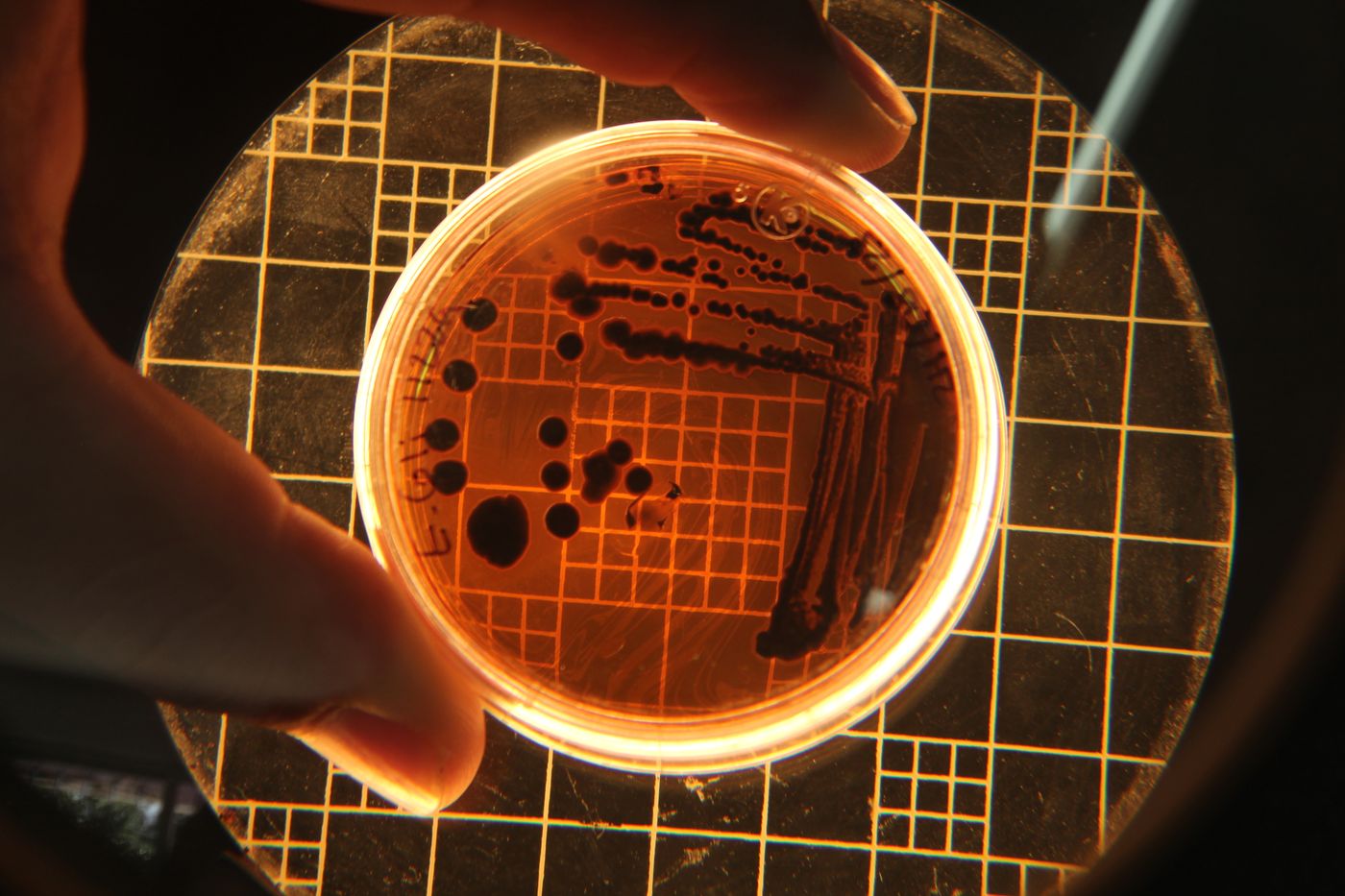
Photo: Wassily Kandark / https://www.pexels.com
You will have seen the statistic: only about 0.1 to 1% of bacteria can be grown in a laboratory. It's called the great plate count anomaly, and it's often deployed as proof that bacteria simply cannot survive without their friends.
It deserves a closer look, because the number is doing more work than it can carry.
Three things worth knowing about that figure
It's from 1995, and it's a range across habitats. The original table gives seawater at 0.001–0.1%, soil at 0.3%, activated sludge at 1–15%. The famous "0.1 to 1%" is the row for a freshwater lake.14 Four orders of magnitude separate the extremes.
It's actively disputed. One 2019 analysis argued a large share of bacteria across major biomes have close cultured relatives; another, months later in the same journal, argued the opposite and picked the method apart.15,16 This is a live scientific argument, not a settled fact.
The gut is the exception. Human-associated communities turn out to be among the most culturable of all,15 and a 2016 Nature paper made the point in its title by culturing the "unculturable" human microbiota — isolating 137 species from healthy donors, and finding that half to two-thirds of gut genera form spores.17
So why does anything resist culturing? Partly the obvious: wrong medium, wrong oxygen level, wrong pH, not enough patience. Partly dormancy. And partly the reason relevant here — some organisms depend on nutrients or signals that neighbors normally supply, which a sterile plate never will. That last problem is real enough that researchers built a device, the iChip, to incubate cells in their native soil so their neighbors can keep feeding them.2
A name on a label tells you almost nothing
Here's the fact from all this research that should change how you shop. Any given E. coli isolate shares only around 20% of its DNA sequence with all other E. coli.2,18 Two organisms with an identical species name can differ across most of their genome — one a harmless gut resident, another the reason you don't eat undercooked mince.
This is the mechanistic reason probiotic effects are specific to the strain rather than the species, which the international scientific consensus on probiotics has said plainly for over a decade.19 It's also why the taxonomy keeps moving: in 2020 the genus Lactobacillus was split into 25 genera, which is why a label may now read Lacticaseibacillus where it once read Lactobacillus casei.20 Same organism. Better filing system.
How we brew Flourish, and what that does and doesn't mean

Flourish contains eleven strains from five families, and they are fermented together in one vessel rather than grown apart and combined afterwards. They share a food source, they metabolize alongside each other, and the liquid you pour is the broth they did it in — organic acids, peptides, free amino acids and all. Nothing is spun off and discarded.
The conventional route looks different. Capsule manufacture generally means fermenting each strain separately, harvesting the cells by centrifugation, adding cryoprotectants, freeze-drying, milling to a powder and blending — a well-documented industrial process described in detail by the people who run it.21 The spent broth, and most of what dissolved into it, goes down the drain at the centrifuge step. The strains are then physically mixed in the capsule, but they arrive there as dried, metabolically inert powder: they have never grown together, and they don't start interacting until they rehydrate in you.
What the evidence supports, and what it doesn't
Co-cultivation genuinely produces something different. A 2023 study grew a nine-strain consortium in continuous co-culture and found its growth and metabolic activity were distinct from an equivalent mix of the same strains grown individually — and in a mouse model of colitis, the co-cultured consortium performed where the mixed one didn't.22 That is a real result about a real mechanism. It is also a mouse study of a different set of strains, and it is not a finding about Flourish.
Nor is a longer strain list automatically better. A review of 65 randomized trials covering nearly 11,000 people found single strains were generally equivalent to mixtures, and concluded that the choice should rest on trial evidence for the specific product rather than on the number of organisms in it.23
And on the broth: fermentation metabolites are certainly in there, and that's the point of not centrifuging them away. Whether a preparation of microbial metabolites delivers a health benefit is a separate question with its own definition and its own evidentiary bar, which the field set out in 2021.24 We think growing them together is the better way to make a living probiotic. We're not going to dress a design philosophy up as a clinical result.
So: eleven strains, one culture, grown the way microbes actually grow. Every batch is third-party tested and cleared for delivery of billions of live CFUs per dose. That's what we make, and that's the claim we'll stand behind.
Flourish is a dietary supplement made to support digestive and microbiome health. It is not a treatment for any condition. Follow the dosage on the label, and check with your doctor before starting a new supplement — particularly if you are pregnant, immunocompromised, seriously ill, or considering one for a child.
Ready to try a living probiotic?
Eleven living strains. One shared culture. One daily shot.
Shop Flourish Original · Shop Flourish Junior · What's inside
A few questions we hear a lot
Does co-fermenting the strains make Flourish work better?
We can't tell you that, because nobody has run the trial that would answer it. What's established is that co-cultured consortia are metabolically different from mixtures of separately grown strains, and that the difference mattered in one preclinical model.22 That's the reasoning behind how we brew. It isn't a clinical claim, and we won't present it as one.
Are more strains better than fewer?
Not by itself. The best available review found single strains generally matched multi-strain mixtures, and that what matters is evidence for the specific product.23 Strain count is a design choice, not a benefit.
Eleven strains from five families — which families?
Lactobacillaceae, Bifidobacteriaceae, Enterococcaceae and Bacillaceae, plus Saccharomyces — which is a yeast rather than a bacterium. Yeast and bacteria co-fermenting in one vessel is the same arrangement that produces kefir and sourdough. The full list is on our product FAQ.
If bacteria can't be grown alone, how does anyone make a single-strain probiotic?
Because plenty of them grow alone perfectly well — including most probiotic organisms, which were selected partly for exactly that. The "hard to culture" statistic comes from environmental samples, mostly aquatic and soil, and applies least of all to the human gut.14,15,17
Is gene swapping between bacteria something to worry about?
It's the reason antibiotic resistance travels as fast as it does,8 and it's why probiotic strains are expected to be identified and characterized at the strain level rather than sold under a genus name.9,19 It's a good question to ask any supplement company, ours included.
Do the bacteria in Flourish stay in my gut?
Mostly no — probiotic organisms are passing through rather than moving in, which is why a daily habit beats an occasional big dose. There's more on that in Best Time to Take Probiotics.
About this article
Written by: Lorilyn Van Dyke, Entegro Health | Originally published: January 2023
Important information
This article is for general education and is not a substitute for professional medical advice, diagnosis, or treatment. Probiotic effects are specific to the strain, the dose and the outcome studied; evidence for one product does not transfer to another, and preclinical or animal findings do not establish a benefit in people. These statements have not been evaluated by the Food and Drug Administration. This product is not intended to diagnose, treat, cure, or prevent any disease.
Sources
- Oxford University Press. Synergy. Oxford Learner's Dictionaries. Source
- Stubbendieck, R. M., Vargas-Bautista, C., & Straight, P. D. (2016). Bacterial communities: interactions to scale. Frontiers in Microbiology, 7, 1234. Source
- Flemming, H.-C., & Wuertz, S. (2019). Bacteria and archaea on Earth and their abundance in biofilms. Nature Reviews Microbiology, 17(4), 247–260. Source
- Hutchison, C. A., Chuang, R.-Y., Noskov, V. N., et al. (2016). Design and synthesis of a minimal bacterial genome. Science, 351(6280), aad6253. Source
- Kreth, J., Merritt, J., Shi, W., & Qi, F. (2005). Competition and coexistence between Streptococcus mutans and Streptococcus sanguinis in the dental biofilm. Journal of Bacteriology, 187(21), 7193–7203. Source
- Morris, J. J., Lenski, R. E., & Zinser, E. R. (2012). The Black Queen Hypothesis: evolution of dependencies through adaptive gene loss. mBio, 3(2), e00036-12. Source
- Soucy, S. M., Huang, J., & Gogarten, J. P. (2015). Horizontal gene transfer: building the web of life. Nature Reviews Genetics, 16(8), 472–482. Source
- von Wintersdorff, C. J. H., Penders, J., van Niekerk, J. M., et al. (2016). Dissemination of antimicrobial resistance in microbial ecosystems through horizontal gene transfer. Frontiers in Microbiology, 7, 173. Source
- Campedelli, I., Mathur, H., Salvetti, E., et al. (2019). Genus-wide assessment of antibiotic resistance in Lactobacillus spp. Applied and Environmental Microbiology, 85(1), e01738-18. Source
- Weeks, P. (2000). Red-billed oxpeckers: vampires or tickbirds? Behavioral Ecology, 11(2), 154–160. Source
- Plotz, R. D., & Linklater, W. L. (2020). Oxpeckers help rhinos evade humans. Current Biology, 30(10), 1965–1969.e2. Source
- Belenguer, A., Duncan, S. H., Calder, A. G., et al. (2006). Two routes of metabolic cross-feeding between Bifidobacterium adolescentis and butyrate-producing anaerobes from the human gut. Applied and Environmental Microbiology, 72(5), 3593–3599. Source
- Culp, E. J., & Goodman, A. L. (2023). Cross-feeding in the gut microbiome: ecology and mechanisms. Cell Host & Microbe, 31(4), 485–499. Source
- Amann, R. I., Ludwig, W., & Schleifer, K.-H. (1995). Phylogenetic identification and in situ detection of individual microbial cells without cultivation. Microbiological Reviews, 59(1), 143–169 — see Table 1 for culturability by habitat. Source
- Martiny, A. C. (2019). High proportions of bacteria are culturable across major biomes. The ISME Journal, 13(8), 2125–2128. Source
- Steen, A. D., Crits-Christoph, A., Carini, P., et al. (2019). High proportions of bacteria and archaea across most biomes remain uncultured — a direct response to the above. The ISME Journal, 13(12), 3126–3130. Source
- Browne, H. P., Forster, S. C., Anonye, B. O., et al. (2016). Culturing of "unculturable" human microbiota reveals novel taxa and extensive sporulation. Nature, 533(7604), 543–546. Source
- Lukjancenko, O., Wassenaar, T. M., & Ussery, D. W. (2010). Comparison of 61 sequenced Escherichia coli genomes. Microbial Ecology, 60(4), 708–720. Source
- Hill, C., Guarner, F., Reid, G., et al. (2014). Expert consensus document: the International Scientific Association for Probiotics and Prebiotics consensus statement on the scope and appropriate use of the term probiotic. Nature Reviews Gastroenterology & Hepatology, 11(8), 506–514. Source
- Zheng, J., Wittouck, S., Salvetti, E., et al. (2020). A taxonomic note on the genus Lactobacillus: description of 23 novel genera. International Journal of Systematic and Evolutionary Microbiology, 70(4), 2782–2858. Source
- Fenster, K., Freeburg, B., Hollard, C., et al. (2019). The production and delivery of probiotics: a review of a practical approach. Microorganisms, 7(3), 83 — written by probiotic manufacturers describing standard industrial practice. Source
- Kurt, F., Leventhal, G. E., Spalinger, M. R., et al. (2023). Co-cultivation is a powerful approach to produce a robust functionally designed synthetic consortium as a live biotherapeutic product. Gut Microbes, 15(1), 2177486 — nine strains, mouse model of colitis. Source
- McFarland, L. V. (2021). Efficacy of single-strain probiotics versus multi-strain mixtures: systematic review of strain and disease specificity. Digestive Diseases and Sciences, 66(3), 694–704 — 65 randomized trials, 10,863 participants. Source
- Salminen, S., Collado, M. C., Endo, A., et al. (2021). The International Scientific Association of Probiotics and Prebiotics (ISAPP) consensus statement on the definition and scope of postbiotics. Nature Reviews Gastroenterology & Hepatology, 18(9), 649–667. Source