Best Time to Take Probiotics
The short answer is whenever you'll actually remember. The longer answer involves stomach acid, a bit of high-school chemistry, and the reason consistency beats clever timing every time.

Photo: Alpz / https://www.pexels.com
Plenty of probiotic products come with timing instructions, and nobody wants to waste a supplement by taking it wrong. So let's do this properly — the timing, and then the thing that matters considerably more than the timing.
First, a refresher on pH
Potential of hydrogen — pH — measures the concentration of hydrogen ions on a scale from 0 to 14. Below 7 is acidic, 7 is neutral, above 7 is alkaline.
The counterintuitive bit worth holding onto: the more acidic something is, the lower the number. Nearly everything below depends on remembering that.
A typical stomach sits somewhere in the pH 1.5 to 3.5 range, depending on what it's doing at the time.1
Why Flourish being a liquid matters
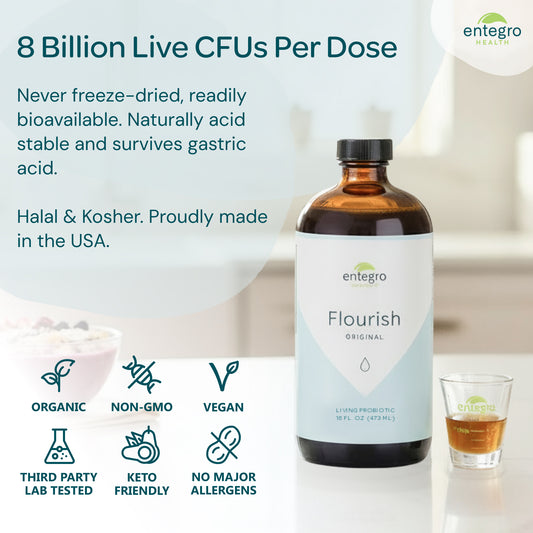
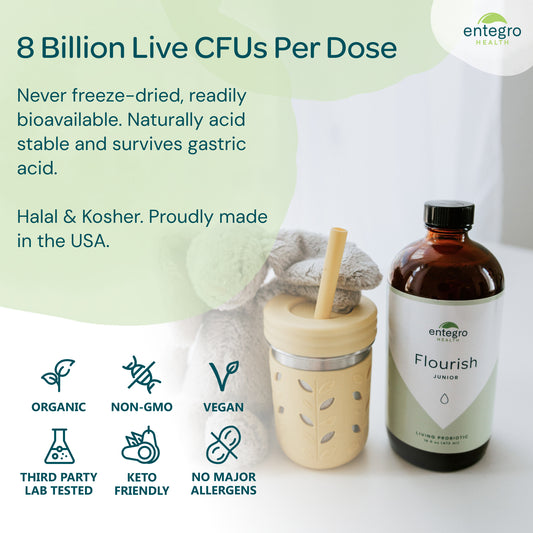
Here's the part we like. The bacteria in Flourish Original and Flourish Junior are acid producers, so the environment they build for themselves during fermentation is acidic — a finished batch sits around pH 2 to 3.
That's inside the range your stomach operates in. Which is both why Flourish tastes tart and why the bacteria in it aren't meeting gastric acid for the first time when they arrive. They've lived in acidic conditions their whole existence, and that's the argument for a living liquid over a freeze-dried powder waking up cold.
So does it matter whether you eat?

Photo: Ioana Motoc / https://www.pexels.com
The research here points in a particular direction, and it isn't the intuitive one.
Eating raises your stomach's pH rather than lowering it. Acid secretion does ramp up when food arrives, but the food itself buffers what's already there, so gastric pH climbs — often to around 4 or 5 — before settling back down. A stomach with breakfast in it is a gentler place than an empty one.2
The most directly relevant study ran a multi-strain probiotic through a model of the human upper digestive tract at different times around a meal. Survival was best with a meal or about 30 minutes before one, and worst 30 minutes after. Meals containing some fat protected better than water or juice did.3
The honest caveat
That study used capsules whose bacteria had no acid protection of their own — which is the problem a fermented living liquid is designed around rather than the problem it has. In the same study, the Saccharomyces yeast wasn't affected by meal timing at all, and Flourish contains a Saccharomyces strain.3
So we're not going to claim the finding doesn't apply to us, and we're not going to claim it proves anything about Flourish specifically either. What we'd say: if you want to hedge, take it with breakfast or just before eating. If you'd rather take it at some other point in the day, that's fine too.
What about medications?
Leave roughly two hours either side. That interval is practical convention rather than a trial-derived figure — the point is simply not to have a supplement and a medication arriving in the same stretch of gut at once.
Antibiotics are the one to be deliberate about, and we go through the detail — including which strain in the bottle antibiotics don't touch — in Probiotics & Medication.
What's actually going on down there

To understand why the schedule matters less than the habit, it helps to know what a probiotic is walking into.
Your gut is home to roughly 38 trillion bacteria — the best current estimate, which also quietly retired the old "ten bacterial cells for every human one" line. It's closer to one to one.4 Most of them live in your colon, and most of them have been there a very long time: one study followed adults for up to five years and found around 60% of their strains still present throughout.5
That community shifts with diet, and quickly — a change of diet moves it within a day. It also springs back within a couple of days of going back to normal.6 Which tells you something useful straight away: a one-off anything does not reshape a microbiome.
Not everybody down there is a good neighbour. Some resident species are pathobionts — organisms that live quietly in most healthy people but can drive inflammation when conditions let them.7 Keeping the balance tipped the other way is most of the job.
The pH trick, again — this time in the colon
When beneficial bacteria ferment the fibre you can't digest, they produce short-chain fatty acids and lactate, and those acidify the gut. Harvard's Nutrition Source puts it plainly: this lowers the pH of the colon, which determines which species survive there, and limits the growth of some harmful bacteria.8
The effect has actually been measured, and it's dramatic. In a fermentor seeded with a human gut community, Bacteroides made up 27% of sequences at pH 5.5 and 86% at pH 6.7. Butyrate producers went the other way — half the community at pH 5.5, undetectable at 6.7. E. coli grew poorly at the lower pH.9 A single point on the scale reorganises the neighbourhood.
Alongside that, beneficial bacteria compete with less helpful ones for food and for somewhere to sit — colonisation resistance, and one of the mechanisms ISAPP describes as widespread across probiotics rather than specific to one strain.10,11,15
Which is exactly why consistency is key

Photo: Jonathan Borba / https://www.pexels.com
Here's the crucial fact, and it's the one that settles the whole timing question: probiotics are passing through. They are not moving in. Studies tracking what happens after a dose find the impact is transient and highly individual, and that what shows up in a stool sample doesn't even reliably tell you what reached the gut lining.12
That isn't a knock. It's the mechanism. The benefit is delivered in transit — the metabolites they make on the way through, the acid they contribute, the space and food they take up while they're there. Which means the supply has to be topped up. Stop, and it stops.
A dose you take every day at an imperfect hour beats a perfectly timed one you take twice a week.
Worth being straight about the limits of this, too. In healthy adults, probiotic supplementation doesn't measurably change the diversity of the resident community.13 So the case for taking it daily isn't that it slowly builds a new microbiome. It's that the useful part happens while the organisms are going past, and you'd like that to be happening regularly.
How long before it's automatic?
Longer than the internet tells you. The best study on habit formation followed 96 people adopting a daily behaviour and found the median time to reach near-automatic was 66 days — with a range from 18 to 254. So much for "21 days."14
Two findings from it are worth stealing. First, what built the habit was repeating the behaviour in the same context — after breakfast, next to the kettle, before brushing your teeth. Attach it to something you already do. Second, and more reassuring: missing a single day made no material difference to the habit forming.14 One skipped dose is not a broken streak. Just pick it up tomorrow.
The thing that most often breaks the habit

Running out. Not forgetting, not bad timing — an empty bottle and a week before the next one arrives. That's the gap that turns a habit back into an intention.
Which is the unglamorous, genuinely useful advice: set it up so the next bottle turns up before the current one is finished, and the decision stops being one you have to keep making.
Where does Flourish fit?
Flourish Original and Flourish Junior are living liquid probiotics — eleven strains, small-batch fermented in Iowa — taken daily to support digestive and microbiome health. The bacteria arrive already living in the acidity they made for themselves, which is the part we think is worth the extra trouble of shipping glass.
Flourish is a dietary supplement made to support digestive and microbiome health. It isn't a treatment for any condition. Follow the dosage on the label. Check with your doctor before starting a new supplement, particularly if you take regular medication, and with your pediatrician before giving one to a child.

Ready to make it a habit?
Eleven living strains. One daily shot. For the whole family.
Shop Flourish Original · Shop Flourish Junior · Why we keep it liquid
And since running out is the thing that breaks the streak, that's what Subscribe & Save is for: 5% off all Subscribe & Save orders, plus free shipping on subscriptions of 2+ Flourish.
A few questions we hear a lot
Morning or night?
Whichever you'll stick to. There's no strong evidence favouring either, and consistency outweighs the difference between them. Pick the one that attaches to something you already do every day.14
With food or without?
If you want to follow the evidence, with a meal or about 30 minutes before one — survival was best in both conditions and worst 30 minutes after.3 That research used uncoated capsules rather than a fermented liquid, so treat it as a sensible default rather than a rule.
Doesn't eating make my stomach more acidic?
The opposite, in the short term. Food buffers the acid already there, so gastric pH rises after a meal — often to around 4 or 5 — before coming back down.2 That's why a meal helps rather than hinders.
How acidic is Flourish compared to my stomach?
Similar, as it happens. A finished batch sits around pH 2 to 3; gastric fluid runs about 1.5 to 3.5.1 The bacteria aren't encountering acid for the first time on the way down.
How long should I leave between my medication and Flourish?
About two hours either way. It's practical convention rather than a trial-derived number — more detail in Probiotics & Medication.
Does missing a day undo it?
No — and there's research behind that rather than just reassurance. In the habit-formation study, missing one opportunity made no material difference to the habit forming.14 Get back to it the next day and don't double up.
Do probiotics stay in my gut once I've taken them?
Generally no. They're transient — they do their work while passing through and are gone within days.12 That's the whole argument for taking them regularly rather than in bursts.
What happens if I stop?
The effects fade with the organisms, since they weren't setting up permanent residence.12 Nothing dramatic happens; the top-up simply stops arriving.
About this article
Written by: Lorilyn Van Dyke, Entegro Health | Originally published: February 2022
Important information
This article is for general education and isn't a substitute for professional medical advice, diagnosis, or treatment. Never change how you take a prescribed medication on the basis of a blog post — speak to your doctor or pharmacist. Probiotic effects are specific to the strain and to the outcome studied; evidence for one product does not transfer to another. Always seek qualified advice before starting a new supplement. These statements have not been evaluated by the Food and Drug Administration. This product is not intended to diagnose, treat, cure, or prevent any disease.
Sources
- Stomach acid test — normal gastric fluid pH 1.5 to 3.5. A.D.A.M. medical encyclopedia content, UF Health. Source
- Le, J. Drug absorption. StatPearls / NCBI Bookshelf — gastric pH, the buffering effect of food, and its influence on what survives the stomach. Source
- Tompkins, T. A., Mainville, I., & Arcand, Y. (2011). The impact of meals on a probiotic during transit through a model of the human upper gastrointestinal tract. Beneficial Microbes, 2(4), 295–303. Source
- Sender, R., Fuchs, S., & Milo, R. (2016). Revised estimates for the number of human and bacteria cells in the body. PLoS Biology, 14(8), e1002533 — 3.8 × 10¹³ bacteria, a bacteria-to-human-cell ratio of about 1.3:1, explicitly revising the older 10:1 figure. Source
- Faith, J. J., Guruge, J. L., Charbonneau, M., et al. (2013). The long-term stability of the human gut microbiota. Science, 341(6141), 1237439. Source
- David, L. A., Maurice, C. F., Carmody, R. N., et al. (2014). Diet rapidly and reproducibly alters the human gut microbiome. Nature, 505(7484), 559–563. Source
- Chow, J., Tang, H., & Mazmanian, S. K. (2011). Pathobionts of the gastrointestinal microbiota and inflammatory disease. Current Opinion in Immunology, 23(4), 473–480. Source
- Harvard T.H. Chan School of Public Health, The Nutrition Source. The microbiome — fermentation of fibre lowers colonic pH, which determines which microbiota survive and limits the growth of some harmful bacteria. Source
- Duncan, S. H., Louis, P., Thomson, J. M., & Flint, H. J. (2009). The role of pH in determining the species composition of the human colonic microbiota. Environmental Microbiology, 11(8), 2112–2122. Source
- Buffie, C. G., & Pamer, E. G. (2013). Microbiota-mediated colonization resistance against intestinal pathogens. Nature Reviews Immunology, 13(11), 790–801. Source
- Hill, C., Guarner, F., Reid, G., et al. (2014). Expert consensus document: the ISAPP consensus statement on the scope and appropriate use of the term probiotic. Nature Reviews Gastroenterology & Hepatology, 11(8), 506–514. Source
- Zmora, N., Zilberman-Schapira, G., Suez, J., et al. (2018). Personalized gut mucosal colonization resistance to empiric probiotics is associated with unique host and microbiome features. Cell, 174(6), 1388–1405.e21. Source
- Kristensen, N. B., Bryrup, T., Allin, K. H., et al. (2016). Alterations in fecal microbiota composition by probiotic supplementation in healthy adults: a systematic review of randomized controlled trials. Genome Medicine, 8(1), 52. Source
- Lally, P., van Jaarsveld, C. H. M., Potts, H. W. W., & Wardle, J. (2010). How are habits formed: modelling habit formation in the real world. European Journal of Social Psychology, 40(6), 998–1009 — median 66 days to near-automatic, range 18–254; missing one opportunity did not materially affect habit formation. Source
- Bermudez-Brito, M., Plaza-Díaz, J., Muñoz-Quezada, S., Gómez-Llorente, C., & Gil, A. (2012). Probiotic mechanisms of action. Annals of Nutrition and Metabolism, 61(2), 160–174. Source