Best Time to Take Probiotics
When is the best time to take my probiotic? Have you ever asked yourself this question? Many probiotic products on the market today have guidelines on when it's best to take them. Who doesn’t want to get the most out of their supplement?

The secret of the liquid nature
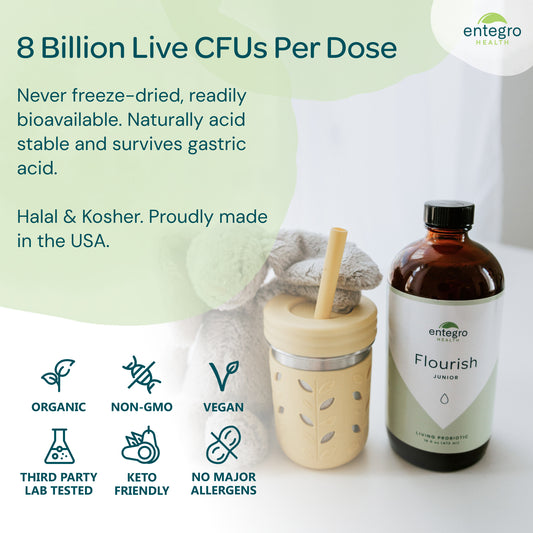
One of the best things about Flourish is the secret of the liquid nature. Flourish bacteria create their own preferred environment. Let me explain. The microscopic bacteria in Flourish (Original and Junior) are acid producing, therefore the environment they create is acidic, just like your stomach.
A quick review of pH
But before we get into that, let’s reach back to our high school chemistry days to review pH. The potential of hydrogen (pH) measures the concentration of H+ ions on a scale from 0 – 14. Acidic solutions are considered 0 – 6 with 7 being neutral. Solutions that measure 8 – 14 are considered alkaline.

The typical stomach has a pH in the 1.5 - 3.5 range, depending on what the needs of the body are.1
As we begin to eat, the body responds by increasing acid production to break down food, although the food itself buffers the stomach, so its pH briefly rises after a meal.2 Remember the way the pH scale works? The higher the acidity, the lower the pH number. So, as the acids in the stomach increase, the pH lowers. The pH of Flourish is in the 2 – 3 range. This not only gives it that delightfully tart flavor, but also a naturally acidic home that the cultures are used to.
The best time to take Flourish

So, to make a short answer long, the best time to take Flourish is any time you’ll remember it consistently, though it may be worth taking it with or just before a meal. However, there are a few things to keep in mind depending on your medication schedule and eating preferences. As with all supplementation, it is best practice to separate supplements and medications by two hours before and after. In one lab model of the digestive tract, other probiotics survived best when taken with a meal or shortly before one.3

Consistency
The other thing to keep in mind with probiotic supplementation for optimal results is (you guessed it) consistency! Supporting gut health through consistent introduction of beneficial bacteria matters because probiotic bacteria tend to pass through rather than stay for good.45 Taken regularly, they add to the pH lowering bacteria who provide competition for bacteria who have a negative potential.6


Ready to try a living probiotic?
Eleven live cultures. One daily shot. For the whole family.
Shop Flourish Original · Shop Flourish Junior · When to take it
About this article
Written by: Lorilyn Van Dyke, Entegro Health | Originally published: February 2022
Important information
These statements have not been evaluated by the Food and Drug Administration. This product is not intended to diagnose, treat, cure, or prevent any disease.
Sources
- Stomach acid test — normal gastric fluid pH 1.5 to 3.5. A.D.A.M. medical encyclopedia content, UF Health. Source
- Le, J. Drug absorption. StatPearls / NCBI Bookshelf — gastric pH, the buffering effect of food, and its influence on what survives the stomach. Source
- Tompkins, T. A., Mainville, I., & Arcand, Y. (2011). The impact of meals on a probiotic during transit through a model of the human upper gastrointestinal tract. Beneficial Microbes, 2(4), 295–303. Source
- Zmora, N., Zilberman-Schapira, G., Suez, J., et al. (2018). Personalized gut mucosal colonization resistance to empiric probiotics is associated with unique host and microbiome features. Cell, 174(6), 1388–1405.e21. Source
- Kristensen, N. B., Bryrup, T., Allin, K. H., et al. (2016). Alterations in fecal microbiota composition by probiotic supplementation in healthy adults: a systematic review of randomized controlled trials. Genome Medicine, 8(1), 52. Source
- Buffie, C. G., & Pamer, E. G. (2013). Microbiota-mediated colonization resistance against intestinal pathogens. Nature Reviews Immunology, 13(11), 790–801. Source